RAISINA DIALOGUE 2026
Executive Summary
New Delhi • March 5–7, 2026 • 11th Edition
Theme: Saṃskāra — Assertion, Accommodation, Advancement
Synthesised from 35 transcribed sessions • 252,000+ words • 150+ speakers
THE DIALOGUE AT A GLANCE
The 11th Raisina Dialogue convened in New Delhi from March 5–7, 2026, against a backdrop of live conflict in West Asia, accelerating great-power realignment, and a US foreign policy reckoning that reshaped every conversation in the room. Organised by the Observer Research Foundation in partnership with India’s Ministry of External Affairs, the dialogue brought together over 150 speakers across 58 sessions spanning three days, three parallel venues, and formats ranging from plenaries and ministerial addresses to invite-only dinners and late-night kahwa conversations.
This year’s theme — Saṃskāra: Assertion, Accommodation, Advancement — drew on a Sanskrit concept of refinement and transformation. It framed India’s evolving posture on the world stage: a nation no longer adjusting to the global order but actively refining it. That framing proved prescient. Over three days, the dialogue surfaced a world in which the old rules are fraying, the rule-makers are themselves breaking ranks, and the most consequential partnerships are being forged not by ideology but by structural convergence and mutual necessity.
The event’s own logistics became a metaphor for the moment. Severe flight disruptions caused by the West Asia conflict forced organisers to cancel 1,200 tickets and reroute 180 delegates through unfamiliar paths to reach New Delhi — a feat ORF President Samir Saran wryly described as his five days as a “travel agent.” The fact that the halls remained full spoke to Raisina’s gravitational pull and to the urgency of the conversations it convenes.
THE FIVE BIG STORIES OF RAISINA 2026
1. A Live War Rewrote the Agenda
The US-Israeli strikes on Iranian infrastructure — including the torpedoing of an Iranian vessel near Sri Lanka during the dialogue itself — turned what would have been a standard geopolitics track into real-time crisis diplomacy. Israeli Foreign Minister Gideon Saar appeared via video to explain Israel’s strategy, declaring that the endgame would be “written by the Iranian people” once conditions for regime change were created. The late-night kahwa session on Day 1 saw panellists debate whether this was a surgical operation or an unbounded campaign to rewrite the regional order, with the consensus crystallising around a phrase that echoed through subsequent sessions: “Regime change means region change.”
The conflict’s shadow extended well beyond the security panels. It informed discussions on energy security (the closure of the Strait of Hormuz), supply chain fragility, the Indian Ocean as a contested theatre, and the urgency of climate-resilient energy systems. External Affairs Minister Jaishankar used the Indian Ocean plenary to deliver his defining statement of the dialogue: “The rise of India will be determined by India. It will be determined by our strength, not by the mistakes of others.”
2. America’s Foreign Policy Reckoning
US Deputy Secretary of State Christopher Landau delivered what amounted to a doctrinal address on Day 1, arguing that American foreign policy had never been properly reassessed after the Cold War ended. The old paradigm — London, Paris, Berlin, Moscow as the axis of engagement — was being replaced by a Western Hemisphere-first approach, with the Indo-Pacific rising as the strategic centre of gravity. Europe, Landau said bluntly, was “a shrinking part of the world’s economic activity.”
The India relationship was singled out as “possibly more than any other one in the world” the partnership that would define the century. Landau framed the two countries as “strategic twins” converging toward a future where, by the 2030s, two $10 trillion economies would partner as equals for the first time in history. The Trump administration’s self-described contribution was empowering officials to question assumptions “that had not been subject to much debate for decades.”
European participants pushed back, but with more pragmatism than protest. Former Swedish PM Carl Bildt, former Canadian PM Stephen Harper, and others acknowledged that the transatlantic alliance faces genuinely open questions about whether it can function when its members see the world so differently. Former Danish PM Rasmussen was blunt on Ukraine: at the current level of support, the war will never end.
3. India’s New Strategic Confidence
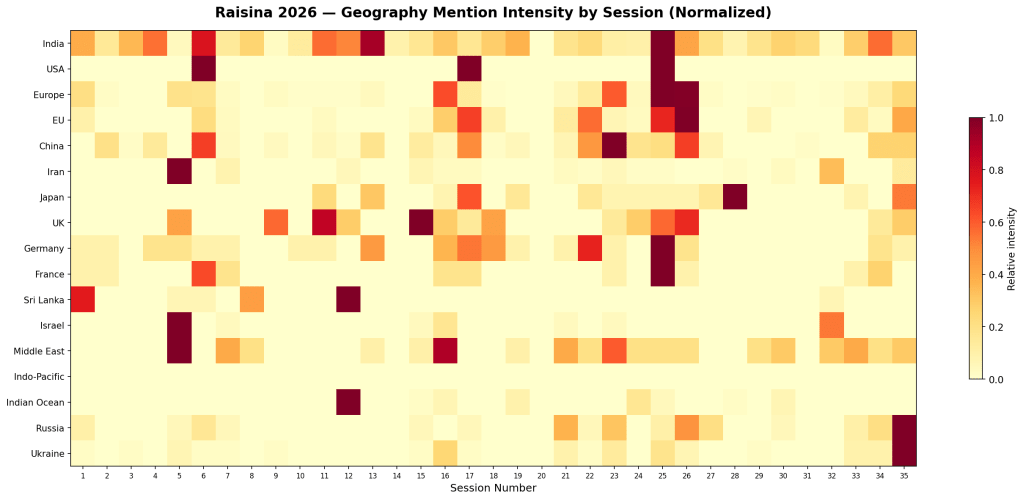
If there was a single protagonist across the 35 sessions, it was India itself — mentioned over 1,000 times in the transcripts, more than double any other geography. But this was not the India of aspiration; it was the India of assertion. Commerce Minister Piyush Goyal laid out the arithmetic of the EFTA deal: a $100 billion FDI commitment, 1 million direct jobs, and a “delta of opportunity” argument that positioned India’s growth from $4 trillion to $30 trillion as the defining investment case of the century. Jaishankar and Foreign Secretary Vikram Misri articulated a foreign policy that demands “equal voice in shaping the rules” while acknowledging that rules framed 80 years ago have lost legitimacy.
Ambassador Neena Malhotra’s spotlight address on the Global South captured the shift most concisely: “For far too long, the Global South has been spoken about. The time has come for it to be spoken with — not just heard, but to lead.” Finland’s President Stubb proposed a “New Delhi Moment” — that India convene world leaders to begin reforming international institutions — effectively endorsing New Delhi as the venue for rewriting the global compact.
4. Technology as the New Terrain of Power
AI dominated the conceptual landscape of Raisina 2026, appearing over 500 times across transcripts — more than any other concept. But the conversation had matured beyond hype. Nandan Nilekani, appearing twice, articulated the sharpest framework: a “race to the bottom” (job displacement, energy consumption, addiction) is currently outpacing the “race to the top” (combating climate change, drug discovery, inclusion). India’s DPI stack — Aadhaar, UPI, DEPA — was positioned as the foundation for a distinctive AI deployment model: inclusive, population-scale, and built on public digital infrastructure rather than private platforms.
The technology panels revealed a tectonic shift in how nations think about tech. The “Tech Triad” session linked AI, autonomous systems, and energy into a single strategic complex, with India’s Chief of Defence Staff discussing nuclear energy for military AI systems and the UK betting on quantum computing as the next frontier. Edge AI — on-device inference for low-connectivity environments — emerged as the key to AI diffusion in the Global South, with Qualcomm’s shift from telecom chips to AI chips presented as a bellwether. Space was framed as the newest domain of great-power competition, with the US Space Command chief and Japan’s national security advisor both signalling deepening partnerships with India.
5. The Fracturing — and Restitching — of Global Order
“Globalization is clearly over. We have entered the age of fracturing.” This declaration from Politico’s Jamil Anderlini opened the Broken Markets panel, and its logic pervaded the economic sessions. Supply chains that were once the crown jewel of the global economy are now being weaponised. A German pharmaceutical CEO reported that her costs from China rose tenfold during COVID; her company’s laser focus is now on reshoring every component to Europe. The IMEC-Three Seas convergence was presented as a new connectivity architecture linking India through the Middle East to Europe’s north-south backbone — a physical counter-narrative to fragmentation.
India’s Chief Economic Adviser V. Anantha Nageswaran framed the paradox clearly: the mechanisms necessary for prosperity — integrated supply chains, cross-border investment, technology flows — are increasingly being used as instruments of punishment. India’s strategy is to first build resilience (its energy and capital flow dependencies constrain autonomy), then leverage its massive market size to become indispensable in restructured global value chains. Japan’s experience with what one panellist called “Chinese blackmail” offered lessons for building counter-leverage.
Climate finance emerged as the critical connecting tissue. The Art of the Impossible panel revealed that compliance carbon markets move $1.2 trillion annually while voluntary markets for renewables stagnate at under $2 billion. Connecting these markets — an outcome pursued at COP 30 — could transform the flow of capital from high-income to low-income countries. India, Indonesia, and Brazil are all building new compliance markets, creating the infrastructure for this shift.
THE RAISINA SIGNAL
Every edition of Raisina captures a mood. In 2026, that mood was not anxiety but resolve. The old order is not collapsing so much as being consciously dismantled by its own architects — and the nations that were once its subjects are no longer waiting for permission to build alternatives. India’s Sanskara framing proved more than ceremonial: it described a world where assertion is discipline, accommodation is strategy, and advancement is purpose.
The closing plenary’s title asked the central question: “When the rule-makers become the rule-breakers, what holds?” The three days in New Delhi suggested an answer: not institutions alone, and certainly not ideology, but the structural convergence of interests between nations that need each other more than they need the old frameworks. The US needs India’s market and demographic dividend. Europe needs India’s tech talent and strategic heft. The Global South needs India’s DPI model and diplomatic muscle. And India needs all of them — but on its own terms, at its own pace, and in service of its own civilisational project.
“Let us combine Finnish happiness and Indian optimism in constructing a fairer and more stable new world order.” — Alexander Stubb, President of Finland, Inaugural Address
 EmergTech