
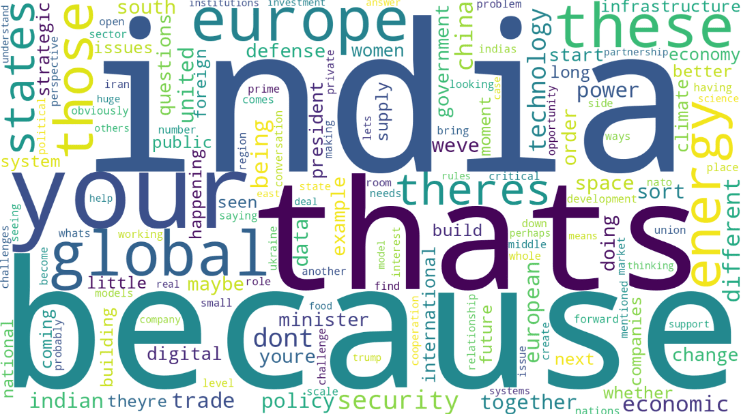
Session Summaries & Key Takeaways
Executive Briefing — 43 Sessions in Chronological Order which are available on Youtube channel of ORF
New Delhi, India — March 5–7, 2026
Prepared from session transcripts, organised by official agenda schedule
TABLE OF CONTENTS
DAY 1 — MARCH 5, 2026
11:30-12:20 [Shahjehan] The Indo-Pacific Pivot: Why NATO’s Credibility Depends on Asia
12:30-13:00 [Shahjehan] US to India: “We Are Your Strategic Twin” — Raisina 2026
12:30-13:00 [Shahjehan] “America First” & India: A New Era of Partnership
13:30-14:20 [Studio] Kill the Gatekeepers: Is DPI the Global Good We’ve Been Waiting For?
13:30-14:20 [Mumtaz] Climate vs. Chaos: Can the Planet Rise Above Politics?
13:30-14:20 [Shahjehan] Talent is Global, Capital is Local: Fixing the AI Skill Gap
18:00-19:00 [Durbar] India: The Force That Will Tilt the World — Alexander Stubb
19:30-21:30 [Shahjehan] The Death of Diplomacy: Is the UN Beyond Repair?
19:30-21:30 [Mumtaz] The Chip Choke Point: Can Global Supply Chains Survive Fragmentation?
21:30-22:30 [Durbar] “The Elephant in the Room”: Why Iran Conflict is Different from Iraq & Afghanistan
DAY 2 — MARCH 6, 2026
08:00-08:50 [Shahjehan] Indo-Pacific Tinderbox: Japan, Australia, and the New Front Lines
08:00-08:50 [Mumtaz] The Energy Cartel? How BRICS+ Is Reclaiming the Global Grid
09:00-09:25 [Durbar] India’s Foreign Policy Vision: Sanskaar, Assertion, Accommodation, Advancement
09:25-10:05 [Durbar] Israeli Foreign Minister Gideon Saar at Raisina Dialogue 2026
09:25-10:15 [Shahjehan] The AI-Enabled Women Era: Reframing Bias and Inclusion for a More Equitable Future
10:15-11:05 [Durbar] “Stop Preaching!”: President Stubb & Jaishankar Unfiltered
10:15-11:15 [Shahjehan] Degrees vs. Data: Why Education Systems Can’t Keep Up with AI
11:15-12:05 [Studio] Women Are No Longer Just the Beneficiaries of Development — They Are the Drivers of It
11:45-12:35 [Mumtaz] Beyond the Field: Integrating Food, Fuel, and National Security
12:25-13:25 [Durbar] Russia’s $2T Miracle: How Moscow Out-Produced the West
13:25-13:35 [Durbar] Shining a Lighthouse: Japan’s Role in the Indo-Pacific
15:35-15:55 [Durbar] Technology Advances like Light — Nandan Nilekani at Raisina 2026
15:35-15:55 [Durbar] AI for Social Good: Nandan Nilekani on the “Race to the Top”
15:55-16:55 [Durbar] The India-Europe Dynamic: Strategic Autonomy and Global Cooperation
17:55-18:45 [Durbar] Connecting Islands of Solutions: Connectivity, Climate and Durable Globalisation
18:55-19:45 [Durbar] US-China Rivalry: The Emergence of a G2 Order
19:50-21:50 [Shahjehan] Broken Markets: Politics, Predators and Disruptive Economics
DAY 3 — MARCH 7, 2026
09:30-09:55 [Durbar] In Conversation with Sanjeev Sanyal — Maritime Miracle
09:55-10:45 [Durbar] The Art of the Impossible
09:55-10:45 [Shahjehan] The Credit Trap: Why Sovereign Ratings Are Failing Emerging Markets
11:20-12:10 [Durbar] India’s Rise: Defined by Strength, Not Others’ Mistakes — Dr. Jaishankar at Raisina 2026
12:10-13:00 [Durbar] Risks, Rivalries and Resilience
13:00-14:30 [Shahjehan] The New Science Diplomacy: Collaboration in the Age of Competition
14:30-15:00 [Durbar] Indian States Are the Ambassadors of Global India
15:00-15:30 [Durbar] The $100 Billion FDI Masterstroke: How India Is Winning the West
15:40-16:30 [Shahjehan] Silicon Everywhere: How Tech is Changing Everything
15:50-16:40 [Durbar] When IMEC Meets the Three Seas
16:40-17:30 [Durbar] The Tech Triad of Power
16:40-17:30 [Durbar] Feeding the Beast: Why AI Needs Nuclear Energy to Survive
17:50-18:00 [Durbar] Time for the Global South: A Long View from New Delhi
18:00-18:25 [Shahjehan] The War Above: Can We Keep Space from Becoming a Battlefield?
18:00-18:50 [Durbar] Clean Energy as Statecraft: Powering Viksit Bharat 2047
18:50-19:40 [Durbar] When the Rule-Makers Become the Rule-Breakers in Geopolitics
DAY 1 — WEDNESDAY, MARCH 5, 2026
11:30-12:20 • Shahjehan • Curtain Raiser
The Indo-Pacific Pivot: Why NATO’s Credibility Depends on Asia
Agenda title: The Future of NATO: Big Budgets, Low Trust
Video: https://www.youtube.com/watch?v=j0SI7aqx5wc
Speakers: Anders Fogh Rasmussen (Former PM, Denmark), Marcos Perestrello de Vasconcellos (MP, Portugal), Benedetta Berti (SecGen, NATO Parliamentary Assembly), Jon Finer (Carnegie/Columbia, USA), Sophie Briquetti (NATO, France). Moderator: Benedikt Franke (Munich Security Conference, Germany)
KEY TAKEAWAYS & INSIGHTS
1. NATO enters 2026 with a paradox: coffers fuller than ever, but trust between partners at a new nadir. Increased defense spending has not translated into improved institutional stability, military readiness, or political predictability.
2. At the current level of support, the Ukraine war will never end. Former Danish PM Rasmussen was blunt: Russia can sustain this level of engagement indefinitely, so only substantially increased European and allied support — economic, financial, and military — can create conditions for a serious peace process.
3. NATO is not crumbling — but the US shift toward a more transactional and detached approach forces the alliance to confront whether its relevance extends to the Indo-Pacific or whether it remains a purely Euro-Atlantic institution.
4. The US-India relationship is a 25-year upward trajectory (with some turbulence) and a “model that other countries and institutions can follow” — Jon Finer framed it as embracing strategic convergence despite Cold War-era differences.
5. The “next elephant” in transatlantic relations: beyond Ukraine and burden-sharing, the panel debated whether NATO’s credibility increasingly depends on its posture toward Asia — particularly whether European allies can contribute meaningfully to Indo-Pacific security frameworks.
6. Benedikt Franke’s moderating style was characteristically direct: “I’m a German officer — when I say you have to ask questions, that means you have to ask questions.” The session was positioned as the curtain-raiser for the US Deputy Secretary of State’s subsequent headline appearance.
12:30-13:00 • Shahjehan • In Conversation
US to India: “We Are Your Strategic Twin” — Raisina 2026
Agenda title: Power, Purpose, & Partnerships: American Foreign Policy in a New Era
Video: https://www.youtube.com/watch?v=bsBdkpBnj3U
Speakers: Christopher Landau (US Deputy Secretary of State). Moderator: Samir Saran (ORF)
KEY TAKEAWAYS & INSIGHTS
1. The US is undergoing a fundamental foreign policy reckoning. Landau stated that for too long, American foreign policy was London-Paris-Berlin-Moscow centric, with “everything else ancillary.” In today’s world, Europe is a “shrinking part of the world’s economic activity” while South and Southeast Asia are going in the opposite direction.
2. The Western Hemisphere is back at the center of US foreign policy — a return to “very traditional roots” that previous administrations had neglected. Landau was ambassador to Mexico in the first Trump administration and sees neighborhood focus as essential.
3. The US-India relationship is framed as potentially “more than any other one in the world” defining the future of the century. By the 2030s, two $10 trillion economies partnering as equals would be unprecedented in history.
4. Landau positioned the Trump administration’s approach as enabling honest dialogue: “Whether you like President Trump or not, he has empowered us to think about fundamental assumptions about foreign policy that had not been subject to much debate for decades.”
5. Saran’s closing reframed the Raisina theme through Landau’s remarks: assertion (enough in the speech), accommodation (determination to partner), and advancement (shared purpose) — and Landau agreed his remarks fit naturally into this framework.
12:30-13:00 • Shahjehan • In Conversation
“America First” & India: A New Era of Partnership
Agenda title: Power, Purpose, & Partnerships: American Foreign Policy in a New Era
Video: https://www.youtube.com/watch?v=2lrggr_HC3Y
Speakers: Christopher Landau (US Deputy Secretary of State)
KEY TAKEAWAYS & INSIGHTS
1. The keynote speech laid out the Trump administration’s foreign policy logic: the post-Cold War period never received a fundamental reassessment of US foreign policy purposes — the Soviet Union vanished and “somewhat strangely” there was never an assessment of what American foreign policy should be in a postcold war world.
2. The US relationship with India has moved from Cold War-era non-alignment tensions to unprecedented cooperation. Landau framed this as possible because India’s non-aligned posture and America’s reassessment of its own alliances have converged on shared interests.
3. Security cooperation is advancing in areas that “would have been impossible some years ago” — preventing terrorism, ensuring freedom of navigation, and defense technology sharing are all accelerating under this administration.
4. Energy cooperation “possibilities are limitless” — signaling that the energy dimension of US-India partnership (including LNG, nuclear, and renewables) is a top priority for the administration.
5. President Trump sent Ambassador Gore — one of his closest advisers — to India, demonstrating that “the president really understands the value of this relationship.” The personnel choice signals strategic priority, not just diplomatic courtesy.
13:30-14:20 • Studio • Studio
Kill the Gatekeepers: Is DPI the Global Good We’ve Been Waiting For?
Agenda title: Peoples’ Platforms: DPI as a Global Public Good
Video: https://www.youtube.com/watch?v=MJiI590UHXU
Speakers: Harsha de Silva (MP, Sri Lanka), Astha Kapoor (Aapti Institute, India), Fernando Pablo de Martin (Madrid City Council, Spain), Sanjay Jain (Gates Foundation), Stephanie Diepeveen (ODI Global, USA). Moderator: Anirban Sarma (ORF, India)
KEY TAKEAWAYS & INSIGHTS
1. India’s DPI stack (Aadhaar, UPI, DEPA) has become the world’s most successful model of population-scale digital infrastructure—Aadhaar covers 99.9% of adults; UPI processes more daily transactions than Visa and Mastercard combined. 23 countries are building digital ID systems with India’s support and 8 nations have adopted UPI.
2. DPI’s “public” refers to public benefit, not necessarily public ownership. The Gates Foundation-World Bank definition frames DPI as foundational reusable digital building blocks designed for public benefit, which can include privately owned but publicly regulated systems like payment platforms.
3. Context matters enormously for DPI replication. Sri Lanka’s Harsha de Silva emphasized that different starting points—existing financial inclusion levels, cultural factors (ID carrying norms from the civil war), language barriers (conversations happening only in English), and bureaucratic turf wars—mean India’s model cannot be copy-pasted. Public buy-in, privacy protection, and human rights must come first.
4. Data sharing as a DPI is far more complex than ID or payments. Astha Kapoor argued that unlike identity (governmental) or payments (banking), data inhabits everyone and takes amorphous forms—different motivations (administrative efficiency vs. sovereignty vs. economic competitiveness) require different data exchange architectures.
5. Europe’s DPI journey is driven by fragmentation. Spain has 17 autonomous regions with separate education and health systems, making interoperability a necessity. Europe has been building digital building blocks for 20+ years, but its approach flows from public administration outward to citizens and companies, unlike India’s more bottom-up model.
6. AI and DPI convergence is the next frontier, opening new possibilities for how digital public infrastructure can be enhanced, though this was flagged as an emerging area requiring further exploration.
13:30-14:20 • Mumtaz • Curtain Raiser
Climate vs. Chaos: Can the Planet Rise Above Politics?
Agenda title: Keeping the Planet Green: The Big Climate Panel
Video: https://www.youtube.com/watch?v=N4gJNogdX74
Speakers: Panel of climate, energy, trade and policy experts (names embedded in transcript)
KEY TAKEAWAYS & INSIGHTS
1. Climate change is no longer a distant issue—heat waves, extreme weather, and the closure of the Strait of Hormuz are making energy security an immediate concern for militaries and societies alike. The Russia-Ukraine war demonstrates daily the vulnerability of fossil fuel supply chains and electricity grids.
2. The geopolitical case for renewables is strengthening independently of the environmental case. Energy sourcing is becoming a national security issue, and the vulnerability of fossil fuel supply chains is driving even skeptics toward diversification.
3. Political trust is the missing ingredient for long-term climate investment. Decision-makers must navigate concerns about supply chain diversification and de-risking while finding new financing routes from European and Gulf banks, institutions, and sovereign wealth funds to high-growth markets.
4. The “bicycle theory” of climate negotiations: like the Doha development agenda for trade, the key is to keep moving forward because stopping means falling over. Don’t let the perfect be the enemy of the good.
5. Private sector momentum is outpacing policy. Despite a “dismal” policy environment, businesses responding to incentives and market opportunities have driven much of the progress to date and will likely continue to be the primary engine of the energy transition.
6. The panel emphasized the need for financing to flow from developed economies to developing ones, where the cost of abatement is often much lower and the impact much greater.
13:30-14:20 • Shahjehan • Curtain Raiser
Talent is Global, Capital is Local: Fixing the AI Skill Gap
Agenda title: Digital Sanskara: The India Story
Video: https://www.youtube.com/watch?v=bMg0M8iY-VQ
Speakers: Anirudh Sharma (Digantara, India), Nicolas Granatino (Stem AI, UK), Rishi Bal (BharatGen, India), Sakshi Gupta (Qualcomm, USA). Moderator: Arun Sukumar (ORF Middle East)
KEY TAKEAWAYS & INSIGHTS
1. Asia will contribute 60% of the world’s economic growth in 2026 (IMF), with AI as a major catalyst — but the critical question is who is prospering and whether this prosperity transforms lives, not just GDP figures.
2. The concept of “digital Sanskara” framed the panel: habituations and learned impressions that drive human actions — connecting ancient Sanskrit philosophy to modern behavioral science (Kahneman and Tversky’s heuristics) to ask whether there is a blueprint for digital prosperity and stability.
3. Edge AI is the key to diffusion in the Global South. Qualcomm’s transition from 5G/6G chips to AI chips enables on-device inference — critical for areas with low connectivity where cloud-based AI is useless. Farmers, oil field surveillance, and healthcare applications all depend on edge deployment.
4. India remains the most important market for AI diffusion — not just as a test case but as a business case. The scale (1.4 billion people), the use cases (agriculture, education, healthcare), and the infrastructure investment make it uniquely positioned.
5. Space technology is evolving faster than expected: companies building lunar logistics programs are now publicly listed, and the race between the US and China for cislunar dominance is creating a new frontier that India’s Digantara is pursuing through Earth-to-Moon tracking sensors.
6. DARPA has been a major funder of fundamental AI research, raising the question: where is the equivalent public investment engine for AI-for-good applications in the Global South? Capital for edge AI deployment remains the missing ingredient.
18:00-19:00 • Durbar • Inaugural
India: The Force That Will Tilt the World — Alexander Stubb
Agenda title: Inaugural Session (PM Modi & President Stubb)
Video: https://www.youtube.com/watch?v=IB_zeiuVVjk
Speakers: Alexander Stubb (President, Finland). Also: Narendra Modi (PM, India), Samir Saran (ORF)
KEY TAKEAWAYS & INSIGHTS
1. The inaugural address was delivered amid extraordinary logistics — Saran spent five days cancelling 1,200 tickets and issuing 180 new ones due to flight disruptions from the West Asia conflict, demonstrating Raisina’s resilience and the commitment of attendees who rerouted to reach New Delhi.
2. Stubb identified three “fatal human mistakes”: over-rationalizing a “peaceful” past that never existed, over-dramatizing a present that is “just as chaotic as history,” and most dangerously, underestimating a future already being written by the Global South.
3. Stubb’s proposal for a “New Delhi Moment”: India should gather world leaders in Delhi to begin the process of reforming international institutions — a procedural call for India to host the defining conversation about what comes after current conflicts.
4. “Might is right” has become the preferred tool of foreign policy — but Stubb argued that the choice between “multipolar opportunistic competition” and “mutually beneficial multilateral cooperation” is precisely that: a choice, not an inevitability.
5. The closing synthesis: “Let’s combine Finnish happiness and Indian optimism in constructing a fairer and more stable new world order” — referencing Finland’s eight consecutive years as the world’s happiest country alongside India’s global leadership in optimism surveys.
6. Raisina is expanding: alongside the flagship New Delhi dialogue, satellite convenings now run in Australia, Japan, UAE, France (Marseilles), and in 2026, a new Raisina Americas launches in Canada.
19:30-21:30 • Shahjehan • Inaugural Dinner
The Death of Diplomacy: Is the UN Beyond Repair?
Agenda title: The Global Crossroads: Assertion, Accommodation, Advancement
Video: https://www.youtube.com/watch?v=MOf7badwN7M
Speakers: Mehdi Jomaa (Former PM, Tunisia), Alexandre Fasel (State Secretary, Switzerland), Shashi Tharoor (MP, India; Chair, Parliamentary Standing Committee on External Affairs), Comfort Ero (International Crisis Group, UK), Jane Holl Lute (Former Deputy Secretary of Homeland Security, USA). Moderator: Rachel Rizzo (ORF)
KEY TAKEAWAYS & INSIGHTS
1. The session posed the hardest question of Raisina 2026: what truly killed effective multilateralism — the actions of the powerful, or the institution’s own inability to enforce solutions? From the Balkans onward, the Security Council has been routinely bypassed by ad-hoc coalitions, economic coercion, and great-power exceptionalism.
2. Shashi Tharoor brought India’s perspective: the UN was born to check unilateral force and deliver collective security, but sovereignty became selective and credibility collapsed. The era of revanchism demands either repairing the old framework or building credible rules outside it.
3. A key counterpoint emerged: the UN creates its own safety valves and parallel systems by design. No country has actually left the UN — even the US, which has ejected itself from specific agencies, remains in the chamber. This survival instinct suggests the institution, however wounded, is not yet a corpse.
4. Peacekeeping and mediation tools were designed for a particular era and have not been objectively relevant in resolving conflicts in the last 2-4 years. The Mali example illustrated how jihadi warfare and new forms of extremism require operational innovations that the traditional UN peacekeeping model cannot deliver.
5. Tunisia’s former PM brought the lived experience of steering a country through its most fragile democratic transition, offering a perspective on what multilateral institutions can and cannot do when domestic and international crises converge.
6. The moderator’s closing framing: the conversation was a “brutal examination of whether this was an autopsy on a living corpse or a deceased one” — conducted under Chatham House rules, allowing speakers to be unusually candid about institutional failures.
19:30-21:30 • Mumtaz • Inaugural Dinner
The Chip Choke Point: Can Global Supply Chains Survive Fragmentation?
Agenda title: Fabs and Faultlines: Who Wins the Chips Race?
Video: https://www.youtube.com/watch?v=rrPYCKftcKs
Speakers: Andreas Schumacher (CSO, Infineon Technologies, Germany), Bambang Brodjonegoro (ADB Institute), Vedica Kant (BCG, India), Kyungjin Song (Advisor to PM, Republic of Korea), Rebecca Arcesati (MERICS, Germany). Moderator: Rudra Chaudhuri (ORF)
KEY TAKEAWAYS & INSIGHTS
1. The semiconductor industry has been shaped by two forces in tension: the old logic of global innovation, global supply chains, and enormous economies of scale; and the new recognition by nations that semiconductors are as foundational to economic wealth and national security as oil.
2. Infineon’s CSO stated the industry reality: in the best of all worlds, semiconductors are one of the most global industries. But geopolitical competition has forced a rethinking — the question is whether resilience can be built without destroying the economies of scale that make chips affordable.
3. Korea’s PM advisor urged Japan to take a more proactive approach in semiconductor partnerships — a notable diplomatic nudge delivered at a multilateral forum, reflecting the jockeying among Asian allies for position in the restructured chip supply chain.
4. From a development perspective, MDBs face a return-on-investment challenge: ITU and others have invested in compute infrastructure in Africa, but demand utilization is only about 2%. Engineering is far ahead of diffusion — the semiconductor supply chain investment case for emerging markets must focus on shared infrastructure (both physical and digital) rather than fabrication.
5. The closing insight challenged binary geopolitical framing: resilience requires thinking about interdependencies in their full complexity rather than reducing the world to two competing blocs. ‘Self-sufficiency’ should be reframed as ‘self-confidence’ — using interdependencies in a self-aware way and choosing partners deliberately.
6. President Stubb’s Raisina maxim — ‘take the world as it is and make the best of it’ — was adopted as the framing principle for semiconductor strategy, suggesting pragmatic engagement over ideological decoupling.
21:30-22:30 • Durbar • Kahwa
“The Elephant in the Room”: Why Iran Conflict is Different from Iraq & Afghanistan
Agenda title: Conversation Over Kahwa | New Middle East Mosaic
Video: https://www.youtube.com/watch?v=TMUJ4sCkdFA
Speakers: Benedikt Franke (Munich Security Conference, Germany), Lina Khatib (Chatham House, UK), Kabir Taneja (ORF Middle East, UAE), Leslie Vinjamuri (Chicago Council on Global Affairs, USA). Moderator: Palki Sharma (First Post, India)
KEY TAKEAWAYS & INSIGHTS
1. The US-Israeli strikes on Iranian infrastructure represent a potential “1989 moment” for the Middle East—a fundamental reordering of the regional order, not just a tactical military operation. The panel debated whether this is a surgical campaign or an unbounded one.
2. The strikes caught even Gulf-based observers off guard. Kabir Taneja, who left Dubai just before the strikes, noted that while military buildup was visible and US bases were being emptied, most people in the region did not expect the timing or scale of what followed.
3. Europe was completely sidelined. The US did not consult European allies before acting. Leslie Vinjamuri noted that the US president has an unconstrained free hand—Congress has not constrained him, the public is not constraining him, and midterm elections won’t affect his ability to continue. European leaders like Kier Starmer are in fundamentally weaker domestic positions.
4. Iran’s strategic position has collapsed. The panel argued Iran is the least strategic actor in the conflict—by attacking neighbors and escalating, it has turned the entire region against it, effectively “nailing its own coffin.” Iran’s military resources have been depleted to the point where replenishment requests went unanswered.
5. “Regime change means region change”—this phrase captured the panel’s consensus that the conflict’s implications extend far beyond Iran to a wholesale restructuring of Middle Eastern power dynamics. The situation remains a “developing story” with profound implications for Indian Ocean security.
DAY 2 — THURSDAY, MARCH 6, 2026
08:00-08:50 • Shahjehan • Panel
Indo-Pacific Tinderbox: Japan, Australia, and the New Front Lines
Agenda title: Beyond Strategic Ambiguity: Rethinking Deterrence in the Taiwan Strait
Video: https://www.youtube.com/watch?v=u7MC15KkbTI
Speakers: Bonnie Glick (FDD, USA), Dhruva Jaishankar (ORF, USA), Helena Legarda (MERICS, Germany), I-Chung Lai (Taiwan-Asia Exchange Foundation, Taiwan), Jonas Parello-Plesner (Alliance of Democracies, Denmark). Moderator: Smita Prakash (ANI, India)
KEY TAKEAWAYS & INSIGHTS
1. With global attention on West Asia, the panel asked whether China sees an opportunity regarding Taiwan. The answer was nuanced: while US attention is diverted, the Iran strikes also demonstrate US military capability and willingness to use force — creating a deterrent signal alongside the distraction risk.
2. Taiwan is a well-functioning democracy of 23 million people, consistently ranked among the world’s freest societies. What is at stake is not just a geopolitical chip but the freedom of a population living under a belligerent neighbor that has been escalating military exercises since August 2022.
3. The PLA Navy’s expanding operational footprint — live-fire exercises in the Philippine Sea, circumnavigation of Australia, growing presence in the Western Indian Ocean and Arctic — indicates China is securing supply lines for a protracted conflict, not just posturing around Taiwan.
4. Chinese vessels have not been deliberately targeted in the Strait of Hormuz during the Iran crisis, which the panel interpreted as revealing: China’s use of Karachi and Djibouti as supply stations, and the emerging pattern of deployments, paints a stark picture of strategic preparation.
5. The Trump-Xi meeting later in the month could prove pivotal. Trump comes with enhanced leverage from demonstrating military capability in both Venezuela and Iran, potentially strengthening the deterrent element of US posture toward China.
6. Long-term, the war in Iran potentially leaves Taiwan more vulnerable as US arms supplies to Taiwan could be delayed or redirected — a concern that Taiwan’s representatives raised directly.
08:00-08:50 • Mumtaz • Panel
The Energy Cartel? How BRICS+ Is Reclaiming the Global Grid
Agenda title: BRICS by BRICS: Building the Other World
Video: https://www.youtube.com/watch?v=cwvxUdvGVig
Speakers: Abdeta D. Beyene (Centre for Dialogue, Ethiopia), Renato Galvão Flôres (FGV, Brazil), Aisha Rasyidila Kusumasomantri (ISI Indonesia), Tan Ya (UIBE, China). Moderator: India’s BRICS chair representative
KEY TAKEAWAYS & INSIGHTS
1. BRICS is now 11 members with 10 partner countries, representing nearly half the world’s population, ~40% of global GDP, and a quarter of international trade. India’s BRICS chairship theme — Vasudhaiva Kutumbakam — frames the grouping as complementary to, not an alternative to, existing international institutions.
2. BRICS’ energy dynamics are shaped by internal diversity: some members are major oil/gas producers, others are large and growing consumers. This creates opportunities for stable long-term partnerships in both traditional and renewable energy, but also internal contradictions on financing, technology access, and policy harmonization.
3. Geopolitical tensions around energy resources are intensifying. The panel acknowledged that despite renewable energy rhetoric, oil and gas remain central to the world economy, and great-power interventions — including in Venezuela and Iran — are fundamentally about energy resource control.
4. The security of global energy transport routes is less certain than ever. Iran (a BRICS member) and the Strait of Hormuz crisis directly impact BRICS countries’ energy security, making maritime passage security a core BRICS concern.
5. The panel called for BRICS to move beyond declarations toward framework strategic documents, standard-setting, and concrete project pipelines. Connectivity routes and mutual standards were identified as priorities — especially given that partner countries are integral to BRICS even without full membership.
09:00-09:25 • Durbar • Ministerial
India’s Foreign Policy Vision: Sanskaar, Assertion, Accommodation, Advancement
Agenda title: Ministerial Remarks (Kirti Vardhan Singh)
Video: https://www.youtube.com/watch?v=n6_3JK5vxd0
Speakers: Kirti Vardhan Singh (Minister of State for External Affairs, India)
KEY TAKEAWAYS & INSIGHTS
1. India’s foreign policy has evolved from “adjusting to a global order” to “refining it.” The Raisina 2026 theme — Sanskara — represents the civilizational process of refinement, where a nation-state moves toward greater capability and purer purpose.
2. The G20 presidency delivered concrete outcomes on development, debt, and digital public infrastructure, guided by Vasudhaiva Kutumbakam (One Earth, One Family, One Future). The New Delhi Leaders’ Declaration is positioned as India’s civilizational response to a polarized world.
3. Three principles for Viksit Bharat 2047: Assert with clarity (red lines on borders, terrorism, technology sovereignty); Accommodate with confidence (institutionalized dialogues like 2+2 formats); Advance with purpose (leverage India-EU FTA and trust frameworks).
4. India moved the global AI conversation from risk to impact: over 90 nations signed the New Delhi Declaration at the AI Summit, and India is investing in indigenous digital capabilities reflecting linguistic diversity and technological sovereignty.
5. A stable international order cannot emerge from the Sanskara of only one civilization or power center. India’s message: assertion, accommodation, and advancement must be “respected, practiced, and shared across the globe” — a universalist framing of a nationally rooted philosophy.
09:25-10:05 • Durbar • Plenary
Israeli Foreign Minister and Palki Sharma Upadhyay at Raisina Dialogue 2026
Agenda title: New Middle East Mosaic (Plenary continuation)
Video: https://www.youtube.com/watch?v=StGLobZNBNU
Speakers: Gideon Saar (Foreign Minister, Israel). Moderator: Palki Sharma Upadhyay (First Post, India)
KEY TAKEAWAYS & INSIGHTS
1. Israel is pursuing regime change in Iran — but through creating conditions for the Iranian people to act, not through direct imposition. Saar stated: “The endgame will be written by the Iranian people” once the oppressive regime is sufficiently weakened to allow internal change.
2. Iran has attacked “not less than 10 countries” including all Gulf states, Cyprus, Azerbaijan, and possibly Turkey. Saar called the regime’s behavior “not sane,” noting it has generated “huge rage all over the region.”
3. Hezbollah joined the war “against the will and interest of the people of Lebanon” on Tehran’s instructions, making Lebanon’s sovereign interests subordinate to Iranian strategic objectives. Israel’s strikes are focused on Hezbollah objectives, not Lebanon broadly.
4. Israel’s skies will reopen “immediately but gradually” — safely reestablishing commercial aviation is a priority. This addressed concerns about stranded Indian nationals in the region.
5. The interview reflected real-time conflict dynamics: an Iranian ship torpedoed near Sri Lanka, Azerbaijan hit, and Beirut evacuations ordered — all within the week of Raisina 2026, making this session an exercise in live crisis diplomacy.
09:25-10:15 • Shahjehan • Panel
The AI-Enabled Women Era: Reframing Bias and Inclusion for a More Equitable Future
Agenda title: Intelligence Bias: Equity, Inclusion, and Growth in the Age of AI
Video: https://www.youtube.com/watch?v=PlmNTfyGfA4
Speakers: Smriti Irani (Former Minister, India), Meredith Walker (Cyber Future Foundation, USA), Marie Véronique Leu-Govind (Minister, Mauritius), Rajesh Gupta (UC San Diego, USA), Tshering Samdrup Dorji (Former CEO, Bhutan). Moderator: Laura Mahrenbach
KEY TAKEAWAYS & INSIGHTS
1. AI is a microcosm of society, imperfections included. Innovation does not equal inclusion—new tools are wielded first by the powerful and can replicate existing power dynamics. Marginalized communities risk benefiting last from AI unless deliberate inclusion is designed in.
2. Smriti Irani provided concrete examples of AI for women’s safety: India’s police departments use AI to predict crime hotspots, allowing real-time adjustments to patrol routes. AI-driven CCTV analysis helps decrease police patrolling costs while improving coverage in vulnerable areas.
3. The legal liability question is complex and consequential. When an enterprise software holder builds applications, legal presumption places responsibility with the application owner. But when applications cross jurisdictions, liability gets split—and critically, consumers dilute their own protections the moment they hit the “I agree” button.
4. Bhutan’s perspective brought a small-state lens: FinTech parks and targeted digital interventions can leapfrog traditional development stages, but only if built with equitable access in mind.
5. The panel identified a core paradox: AI is developed by big states and big tech, which risks repeating history where transformative technologies benefit the powerful first. Deliberate policy intervention is needed to redirect AI’s benefits toward marginalized populations, particularly women.
10:15-11:05 • Durbar • Authors Corner
“Stop Preaching!”: President Stubb & Jaishankar Unfiltered
Agenda title: Authors Corner: The Geometry of Power (Stubb & Jaishankar)
Video: https://www.youtube.com/watch?v=Y5zs2DiEhK8
Speakers: Alexander Stubb (President, Finland), S. Jaishankar (EAM, India), Wiebke Winter (Bremen State Parliament, Germany), Vali Nasr (Johns Hopkins, USA). Moderator: Samir Saran (ORF)
KEY TAKEAWAYS & INSIGHTS
1. President Stubb presented his “Triangle of Power” thesis: the world has moved from bipolar (Cold War) to unipolar (US-led post-1989) to the current multipolar disorder. He frames the world through three pillars — the US, China, and a swing group including India and the EU — arguing that this triangle will define geopolitical outcomes.
2. Jaishankar delivered a signature line: “The last 70 years represent only 1% of Indian history” — challenging the Western tendency to frame India’s trajectory within a post-WWII paradigm and asserting that India’s civilizational depth gives it a fundamentally different strategic orientation.
3. “Global South” is an emotion, not just a demographic. The panel debated whether the term has analytical utility or whether it primarily captures a shared feeling of exclusion from rule-making, making it politically powerful but strategically diffuse.
4. India reconciles multilateralism and multipolarity: Jaishankar stated India is a “firm believer in multilateralism” while recognizing multipolarity as reality — and can reconcile both, just as it reconciles national interests with international obligations.
5. The panel agreed that international organizations, while imperfect, are better than their absence. Jaishankar used the UN as an example: India strongly advocates reform but would not prefer a world without it — the task is to “differentiate between the baby and the bathwater.”
6. This was the first Raisina “Author’s Corner” with a visiting head of state on the main stage — reflecting the dialogue’s ambition to blend intellectual engagement with high-level diplomacy.
10:15-11:15 • Shahjehan • Panel
Degrees vs. Data: Why Education Systems Can’t Keep Up with AI
Agenda title: Labour in Motion: Mobility in the Technopolar Age
Video: https://www.youtube.com/watch?v=BEhNfcAB4_0
Speakers: Alexander Schallenberg (Former Chancellor, Austria), František Ružička (Deputy SecGen, OECD), Sanjeev Krishan (Chairman, PwC India), Radhicka Kapoor (ILO), Zubin Karkaria (VFS Global, virtual). Moderator: Carolin Albrecht (Berlin Global Dialogue, Germany)
KEY TAKEAWAYS & INSIGHTS
1. The global workforce is caught between two conflicting forces: states’ desire to take back control of borders and labor markets, and the borderless diffusion of technology that makes innovation geography-agnostic. This contradiction is producing a growing mismatch between available and needed skills.
2. Labor mobility is no longer about filling shortages — it is about enabling innovation ecosystems to function. High-skilled mobility connects research to industry, startups to global markets, and ideas to implementation. Failure to align mobility, skills, and innovation policy risks slowing technological adoption.
3. Migration systems need to work faster without sacrificing precision. AI can accelerate administrative processing, but the deeper bottlenecks are structural: lack of bilateral agreements on skills recognition, absence of talent pipelines between countries, and immigration frameworks designed for permanent settlement rather than dynamic circular mobility.
4. Finland framed talent attraction as a whole-ecosystem challenge: world-class research, predictable regulation, and a society where families can build stable lives. Salary and taxation alone are not decisive — the quality of the surrounding environment determines whether talent stays.
5. For India specifically, the demographic dividend requires creating pathways that let skilled workers move to countries of destination while retaining the right to return. Counselor ecosystems and documentation processes (via VFS Global’s 70-government network across 150 countries) are the practical infrastructure connecting talent to opportunity.
6. Pension system collapse in aging economies, competition between nations for the same talent pools, and the shift from sector-based to dynamic cross-sector labor mobility were identified as the three structural forces reshaping workforce policy globally.
11:15-12:05 • Studio • Studio
Women Are No Longer Just the Beneficiaries of Development — They Are the Drivers of It
Agenda title: Women-Led Collectives: Revolutionising Rural Economies
Video: https://www.youtube.com/watch?v=nJ9z8D9TxPI
Speakers: Priyanka Chaturvedi (MP, India), Chevaan Daniel (Capital Maharaja Group, Sri Lanka), Gwendoline Abunaw (Ecobank Cameroon), Jackline Kagume (IEA, Kenya), Sunaina Kumar (ORF). Moderator: Ana Katarina Horneta (IDOS, Germany)
KEY TAKEAWAYS & INSIGHTS
1. India’s National Rural Livelihoods Mission (NRLM) stands as a global benchmark for women-led economic transformation. Women’s self-help groups are driving financial inclusion, entrepreneurship, and community resilience at an unprecedented scale in rural India.
2. PM Modi’s G20 framing of “women-led development” (not just women’s development) represents a paradigm shift—women are positioned at the forefront of India’s growth story, not as passive beneficiaries but as active drivers.
3. Structure and culture are mutually reinforcing barriers. Structural reforms (legal protections, financial access, institutional design) and cultural change (norms around women’s mobility, work, and leadership) must advance together—neither alone is sufficient.
4. The cross-regional comparison revealed common patterns: Kenya, Cameroon, Sri Lanka, and India all face challenges of women’s economic participation, but the institutional design of programs like NRLM offers scalable lessons for sub-Saharan Africa and South Asia.
5. At current rates of progress, gender equality is nearly 300 years away—and regression is visible in many areas. The panel’s closing message: this is “not an option” and requires sustained structural investment alongside cultural transformation.
6. The panel noted that enabling women to participate economically requires addressing the unpaid care burden—women can only “go out and do this” when domestic support structures exist.
11:45-12:35 • Mumtaz • Panel
Beyond the Field: Integrating Food, Fuel, and National Security
Agenda title: Recipes for Resilience: Food Security and Geopolitics
Video: https://www.youtube.com/watch?v=KLfADkoaVIM
Speakers: Scott Moe (Premier, Saskatchewan, Canada), Brook Cunningham (Corteva Agriscience), David Laborde (FAO, UN), Mudit Kapoor (ISI Delhi, India). Moderator: Lydia Powell (ORF, India)
KEY TAKEAWAYS & INSIGHTS
1. Food security is now a first-order geopolitical issue. Conflict-driven trade disruptions, extreme weather events, and political manipulation of food markets have turned agricultural supply chains into strategic vulnerabilities, particularly for import-dependent nations.
2. Food has been weaponized through trade blockades, attacks on agricultural infrastructure, and market manipulation. In fragile agricultural economies, armed groups embed themselves within food production and distribution systems, using control over land and inputs as a source of revenue and power.
3. Modern agriculture’s digital dependency creates new attack surfaces. Data-driven supply chains, automated storage, and logistics platforms introduce cybersecurity risks that compound existing physical vulnerabilities.
4. The India-Canada agricultural partnership offers a model of complementary strengths. Saskatchewan (1.25 million people) has deep agricultural R&D capacity, while India (1.4 billion people) has the ability to scale technology rapidly. Agreements signed during the dialogue connect institutions like NIFM and the University of Saskatchewan for nutritional outcomes benefiting 2.5 billion people.
5. The FAO representative emphasized that the world cannot afford to view food, fuel, and national security as separate policy silos—integrated approaches are essential for resilience.
12:25-13:25 • Durbar • Plenary
Russia’s $2T Miracle: How Moscow Out-Produced the West
Agenda title: Forgers of Peace: Ordnance Factories for the Liberal Order
Video: https://www.youtube.com/watch?v=kO6UOg__cSE
Speakers: Admiral Dinesh K. Tripathi (Chief of Naval Staff, India), Lt. Gen. Susan Coyle (Chief of Joint Capabilities Group, Australia), Benedikta Von Seherr-Thoss (EEAS, EU), Abhishek Singh (Rolls Royce Defence, India), Ji Yeon-Jung (ROK Naval Academy, Korea). Moderator: Philip Green
KEY TAKEAWAYS & INSIGHTS
1. Russia, a $2 trillion economy, has outpaced NATO’s combined $50 trillion GDP in sustaining its war of attrition — exposing deep structural atrophy in the Western defence industrial base. Despite heavy sanctions, Moscow expanded artillery and missile production while Western allies struggled with fragile supply chains and workforce shortages.
2. Europe’s ‘independence moment’ is not rhetoric but necessity. The EU’s Benedikta Von Seherr-Thoss stated that Europe needs to act independently where needed, diversify dependencies across energy, trade, and security, and build partnerships globally — with the India-EU security and defense partnership as a key example.
3. India’s Navy has declared a goal of becoming fully Atmanirbhar (self-reliant) by 2047 or earlier. The defence ecosystem now includes 16 DPSUs, 460+ licensed companies, ~16,000 MSMEs, and the world’s second-largest defence startup ecosystem. Niche technologies still require partnerships through co-development and co-production frameworks.
4. The threat environment is multi-dimensional and its pace is the biggest challenge. Lessons from Ukraine on defending against low-end threats must coexist with preparation for near-peer Pacific conflict — and now, lessons from the Iran crisis.
5. Australia’s Lt. Gen. Coyle reinforced that geographic distance no longer provides security: threats don’t stop at borders, and what happens in Europe or West Asia directly affects countries across the globe. Diversification of partnerships — not just alliance management — is the operative strategy.
13:25-13:35 • Durbar • Spotlight
Shining a Lighthouse: Japan’s Role in the Indo-Pacific
Agenda title: Spotlight (Japan – Gen. Oue)
Video: https://www.youtube.com/watch?v=JiWra0HFsLI
Speakers: Gen. Sadamasa Oue (Special Advisor to PM for National Security, Japan)
KEY TAKEAWAYS & INSIGHTS
1. A deeply personal spotlight address: General Oue, who served 36 years in uniform before entering the private sector, was called back to public service by PM Takai with the words “Devote yourself once more to the public good” — framing his return through the Hindu concept of dharma (moral duty).
2. Japan’s civilizational connection to India was invoked through Nara — the ancient capital and Silk Road terminus where the Great Buddha of Todai Temple was consecrated 1,200 years ago by a priest who traveled from India. This historical thread anchors the contemporary Free and Open Indo-Pacific vision.
3. Japan is committed to working with like-minded countries to directly strengthen deterrence and response capability in the Indo-Pacific region — a significant statement from a country constitutionally constrained on military matters.
4. On the Iran situation, Japan’s position is pragmatic: Middle East peace and stability, energy security, and maintaining the non-proliferation regime are of “utmost importance,” with continued diplomatic efforts in coordination with the international community.
5. The closing image — “A thousand years ago, wisdom traveled from India to Japan. Today, Japan and India are together sowing the seeds of hope called the Free and Open Indo-Pacific” — captured the session’s blend of civilizational resonance and strategic partnership.
15:35-15:55 • Durbar • In Conversation
Technology Advances like Light — Nandan Nilekani at Raisina 2026
Agenda title: In Conversation with Nandan Nilekani (AI for Social Good)
Video: https://www.youtube.com/watch?v=qj7G3j_st9I
Speakers: Nandan Nilekani (Co-founder, Infosys; Architect of Aadhaar) and Rohini Nilekani. Moderator: Arun (Ashoka University / ORF)
KEY TAKEAWAYS & INSIGHTS
1. DPI and AI convergence is the defining technological opportunity of this decade. Nilekani argued that India’s unique digital foundations (Aadhaar, UPI, DEPA) position it to build AI that is inclusive, safe, and deployable at population scale—a model distinct from both the US (private-sector driven) and China (state-driven) approaches.
2. India’s DPI success was enabled by a combination of political will, technical talent, and the fact that hundreds of millions had nothing—making digital inclusion a clear positive. Replicating this elsewhere requires understanding that the “India model” inspired 30+ Global South countries precisely because it was not a Western development model.
3. The talent gap is the biggest challenge for DPI replication. When India built its stack, many of the solutions were pioneering and unknown—meaning talent was cultivated through doing, not imported. Other countries need to build similar learning-by-doing ecosystems.
4. Trust compounds: “If you start with trust you end up with more trust; if you start with distrust you end up with even more distrust.” Nilekani’s leadership philosophy emphasizes that leaders should be ambitious in vision but humble in execution.
5. Longevity, mental health, and new technology frontiers are areas Nilekani is personally investing in, signaling where India’s next wave of innovation may emerge.
6. Nilekani’s advice to young leaders: carry a pocket mirror—be ambitious but maintain self-awareness and humility, because driving change in government or elsewhere is fundamentally difficult.
15:35-15:55 • Durbar • In Conversation
AI for Social Good: Nandan Nilekani on the “Race to the Top”
Agenda title: In Conversation with Nandan Nilekani (AI for Social Good)
Video: https://www.youtube.com/watch?v=4ZSMjnldLcs
Speakers: Nandan Nilekani (Co-founder, Infosys). Also featuring: Stefan Löfven (Former PM, Sweden), Alexander Schallenberg (Former Chancellor, Austria), Almut Möller (European Policy Centre), Garima Mohan (German Marshall Fund), Leslie Vinjamuri (Chicago Council). Moderator: Rudra Chaudhuri (ORF)
KEY TAKEAWAYS & INSIGHTS
1. Nilekani framed two simultaneous AI races: the “race to the bottom” (job displacement, energy/water consumption, addiction, loneliness companions) is currently outpacing the “race to the top” (combating climate change, global hunger, drug discovery). Making AI successful globally requires accelerating positive applications to match or exceed negative ones.
2. The hundreds of billions being spent on AI are mainly fueling better/stronger models — but Nilekani argues this model-building race is “a race to the bottom.” The real question is whether AI can be deployed for societal benefit at the same speed it’s being deployed for commercial extraction.
3. Europe’s regulatory dilemma was sharply articulated: cutting EU-level regulation doesn’t mean less regulation — it means 27 different national regulations. The answer is harmonization, not deregulation, making the EU single market easier to navigate rather than fragmenting it further.
4. The transatlantic relationship is changing permanently — not temporarily. Former Swedish PM Löfven argued that the shift transcends any single US administration and Europe must “strengthen ourselves but also build alliances” with like-minded partners rather than individually negotiating with Washington.
5. Europe’s mood has shifted from “complaining” to seeking opportunity. Austrian ex-Chancellor Schallenberg urged value-based realism: take the world as it is and identify the “generational mission” of ensuring global transformation creates more winners than losers.
6. The panel drew a direct line between AI governance, transatlantic drift, and Global South partnership: India and Europe working together on AI standards could set norms that are “not just beneficial to both blocks but for the world at large.”
15:55-16:55 • Durbar • Plenary
The India-Europe Dynamic: Strategic Autonomy and Global Cooperation
Agenda title: Essential Bilateral: Will India and Europe Redefine Autonomy Together?
Video: https://www.youtube.com/watch?v=TnVLAskTkI8
Speakers: Clara Volintiru (Secretary of State, Romania), Benjamin Haddad (Minister Delegate for Europe, France), Carolin Albrecht (Berlin Global Dialogue, Germany), Subhrakant Panda (Indian Metals & Ferro Alloys, India), Ummu Salma Bava (JNU, India). Moderator: Kevin, with opening remarks by India’s Ambassador to Europe
KEY TAKEAWAYS & INSIGHTS
1. India-Europe relations have undergone a qualitative transformation: 18 strategic partnerships with individual European countries, 30+ heads of state/government visits in the last two years alone, and 150+ ministerial visits. Of the 20 heads of state at India’s AI Impact Summit, 10 were European.
2. Europe is not one country — and that’s an asset, not just a problem. Carolin Albrecht argued that frustration with the EU’s inability to act as a single entity is misplaced; the EU was never designed that way. The better approach is a “Europe of projects” — building coalitions on specific issues rather than pursuing unity at all costs.
3. The India-EU strategic partnership completed two decades in 2025, and both its scope and depth have transformed. The India-Finland strategic partnership in digitalization and sustainability, signed during Raisina, was the 18th such European bilateral partnership.
4. The India-EU FTA negotiations represent a new chapter: Europe recognizes India not just as a market but as a partner for setting global standards on AI, quantum computing, and technology governance — areas where joint standard-setting could benefit the world, not just both blocs.
5. The mood in Europe is shifting from complaint to action. The panel noted a change from months earlier when European discussions were dominated by anxiety about US policy and transatlantic relationship deterioration. Now there’s a “generational mission” framing: make the global transformation produce more winners than losers.
6. The human element — student exchanges, R&D collaboration, young population interface — was identified as where the greatest long-term impact of India-Europe partnership will be felt, more so than trade volumes alone.
17:55-18:45 • Durbar • Plenary
Connecting Islands of Solutions: Connectivity, Climate and Durable Globalisation
Video: https://www.youtube.com/watch?v=G17sCBRH2xg
Speakers: Ian Borg (Deputy PM & FM, Malta), Mohamed Nasheed (Former President, Maldives; SecGen, Climate Vulnerable Forum), Dino Patti Djalal (Foreign Policy Community, Indonesia), Fane Kite (Royal Oceania Institute, Tonga). Moderator: Suzannah Jessep (Asia NZ Foundation)
KEY TAKEAWAYS & INSIGHTS
1. Island and archipelago nations are not marginal — they are strategic focal points that anchor vital trade corridors, digital arteries, and maritime infrastructure. The chess metaphor: even the smallest pieces shape the flow of play and can change the outcome.
2. The Maldives’ existential reality: 80% of the country lies less than 1 meter above sea level. With $54 billion stripped from USAID and other development partners pulling back, the Maldives must shift from being a “moral voice” to a “rule shaper” in climate governance.
3. The Kiribati displacement crisis is already real — not hypothetical. Entire populations are planning for the loss of their homeland, and the question of how to relocate with dignity, culture, and independence intact is “a major issue” that the international community has not adequately addressed.
4. ASEAN dual citizenship was proposed as an important gesture for regional integration. Indonesia’s Dino Patti Djalal argued that statelessness is growing and ASEAN countries should offer dual citizenship — though the political barriers remain significant.
5. Small island states are “quietly shaping the next phase of globalization” through smart partnerships, technology leveraging, and coalition building (Climate Vulnerable Forum, V20) — proving that lack of economic or military heft does not preclude strategic influence.
6. The panel’s framing challenged the “dog eat dog” narrative: island states are demonstrating that connectivity, climate action, and coalition politics can be more durable foundations for globalization than great-power competition.
18:55-19:45 • Durbar • Plenary
US-China Rivalry: The Emergence of a G2 Order
Agenda title: Imbalance of Power: Transatlantic Drift and a Rising China
Video: https://www.youtube.com/watch?v=IWfvnXfzAZQ
Speakers: Carl Bildt (Former PM, Sweden), Stephen Harper (Former PM, Canada), Tomáš Petříček (Former FM, Czech Republic), Bonnie Glick (FDD, USA), Carla Sands (America First Policy Institute, USA). Moderator: Palki Sharma (First Post, India)
KEY TAKEAWAYS & INSIGHTS
1. The transatlantic partnership faces an existential test. For 70 years Europe outsourced hard security to the US while focusing on economic integration. Carl Bildt acknowledged the premise while noting European conventional forces were always substantial — but nuclear deterrence dependency remains the critical gap.
2. Stephen Harper framed the core uncertainty: under the current US administration, there are “radically different worldviews” between Washington and European capitals. Whether the alliance can function strategically when its members see the world differently is genuinely an open question.
3. The panel identified a structural shift toward a US-China G2 dynamic, where the bilateral relationship between Washington and Beijing increasingly determines outcomes for everyone else — raising the question of whether middle powers and Europe become rule-takers in a bipolar framework.
4. The Palestinian issue remains the unresolved “cancer” in the Middle East. Carl Bildt argued forcefully that long-term regional stability is impossible without a two-state solution, and that neglect of this issue by Americans, Europeans, and others has allowed it to periodically explode.
5. The America First perspective (Carla Sands) argued that deeper Middle East peace could emerge from the current strikes — positioning the military campaign as potentially opening rather than closing diplomatic pathways. The panel did not reach consensus on this optimistic reading.
6. Voted “the most fun conversation of the day” by audience feedback — suggesting that frank disagreement between former heads of government resonated more than diplomatic consensus.
19:50-21:50 • Shahjehan • Dinner Panel
Broken Markets: Politics, Predators and Disruptive Economics
Video: https://www.youtube.com/watch?v=jjdWoUaeiIY
Speakers: Michał Baranowski (Deputy Minister, Poland), Abla Abdel Latif (Egyptian Centre for Economic Studies), Brendan Nelson (Boeing Global, Australia), Matthias Berninger (Bayer, USA), Stormy-Annika Mildner (Aspen Institute, Germany). Moderator: Jamil Anderlini (Politico, Belgium)
KEY TAKEAWAYS & INSIGHTS
1. “Globalization is clearly over. We have entered the age of fracturing.” The moderator, who lived in China for 22 years before moving to Brussels, framed the panel around the fundamental rupture in supply chains, alliances, and sea lanes that defined the post-Cold War era.
2. The power framework has overtaken the prosperity framework in trade. Poland’s deputy minister noted that analyzing trade through the lens of power rather than prosperity is proving far more useful — and this shift is “something very new” in how governments approach economic policy.
3. Reshoring has become a CEO-level priority. A German pharmaceutical CEO’s experience during COVID — when supply costs from China increased tenfold overnight — has driven a “laser focus” on reshoring every part of the supply chain to Europe. This pattern is replicating across industries.
4. The asymmetry of interdependence is the core vulnerability: “Others can disrupt us more than we can disrupt them.” Nations and firms are now mapping their dependencies to identify where they are on the “less mutually assured” side of economic relationships.
5. South-South trade remains surprisingly weak relative to North-South and North-North trade. The Aspen Institute’s Mildner argued that strengthening regional integration and reducing regulatory and tariff barriers in the Global South could create significant welfare gains.
6. Boeing’s global perspective brought the aviation/defense industry view: supply chain complexity in aerospace means that “friend-shoring” requires years of capability building and cannot simply be decreed by policy — industrial ecosystems take time to reconstruct.
DAY 3 — FRIDAY, MARCH 7, 2026
09:30-09:55 • Durbar • In Conversation
In Conversation with Sanjeev Sanyal — Maritime Miracle
Agenda title: In Conversation with Sanjeev Sanyal
Video: https://www.youtube.com/watch?v=qhmk1u_TLiM
Speakers: Sanjeev Sanyal (Member, PM’s Economic Advisory Council, India). Moderator: Gautam Chikermane (VP, ORF)
KEY TAKEAWAYS & INSIGHTS
1. India was historically a seafaring civilization, and Sanyal undertook a personal maritime voyage in a traditionally built stitched ship to prove this thesis—connecting his book “Ocean of Churn” with lived experience of ancient Indian Ocean navigation.
2. India has the technology to build ship hulls and structures but lacks material sciences for large marine engines. Modern ships use gigantic two-stroke engines (each the size of a four-story building) running on dirty oil, and only 4-5 companies globally (Wartsila, MAN, Mitsubishi) can build them.
3. The maritime engine industry is in flux. The shift away from polluting fuels is creating an opportunity for new entrants, but India needs a wider ecosystem of suppliers and materials science capabilities—a 10-year development horizon.
4. India’s shipbuilding ambitions connect to its broader “Viksit Bharat” vision. Building indigenous maritime capability is framed not just as industrial policy but as reclaiming a civilizational heritage of Indian Ocean trade and navigation.
5. The voyage in a traditional stitched ship provided a visceral connection to India’s ancestors who sailed the Indian Ocean—Sanyal described feeling “proud of my ancestors who may have done these voyages all over the Indian Ocean.”
6. The conversation bridged history, economics, and industrial policy—reflecting Sanyal’s distinctive approach of using historical narrative to inform contemporary strategic thinking.
09:55-10:45 • Durbar • Plenary
The Art of the Impossible
Agenda title: The Art of the Impossible: Finding Trillions for the Transition
Video: https://www.youtube.com/watch?v=49Ot6a9EN8w
Speakers: Niels Annen (State Secretary, Germany), Dag Huse (Norges Bank, Norway), Jayant Sinha (Former Minister, India), Rachel Kyte (UK Climate Representative), Rohini Pande (Yale University). Moderator: Jayant Sinha
KEY TAKEAWAYS & INSIGHTS
1. The risks of an orderly climate transition have “dramatically enhanced” with the US withdrawing not only from the Paris Agreement but potentially exiting the UNFCCC entirely—removing a key pillar of the international climate architecture.
2. Global carbon markets are the key unlocking mechanism. Compliance carbon markets currently move $1.2 trillion annually, while voluntary markets for renewables and land use stagnate at under $2 billion. Connecting and scaling these markets could transform climate finance flows from high-income to low-income countries.
3. Investing in developing-world grid infrastructure for renewables is far cheaper than retrofitting developed-world industrial systems. Parts of India are still building out their grid, and investing in renewable-capable infrastructure upfront is dramatically more cost-effective than retrofitting later.
4. Deforestation accounts for 12-20% of global emissions annually and has much lower abatement costs than industrial decarbonization—making nature-based solutions a critical and underinvested pathway.
5. COP 30 outcomes emphasized moving toward an “open coalition of compliance carbon markets” that could become interoperable across countries—with India, Indonesia, and Brazil among the countries bringing on new compliance markets.
6. The panel reframed the title: the session was about the “art of the possible” and argued that combining the art and the science of the possible can address the transition away from fossil fuels. The consensus: we must not move into an existential crisis at 2°C warming.
09:55-10:45 • Shahjehan • Panel
The Credit Trap: Why Sovereign Ratings Are Failing Emerging Markets
Agenda title: Development by Design: Scripting the Next Global Growth Story
Video: https://www.youtube.com/watch?v=do_PUmbr17Q
Speakers: Alexander Boehmer (OECD), Kwame Owino (IEA, Kenya), Louise van Schaik (Clingendael, Netherlands), Mehul Pandya (CareEdge Group, India), Neelkanth Mishra (PM’s Economic Advisory Council / Axis Bank, India). Moderator: Monika Halan
KEY TAKEAWAYS & INSIGHTS
1. The three dominant credit rating agencies — S&P, Moody’s, and Fitch — function as gatekeepers of global capital, but their sovereign ratings are increasingly seen as biased nudges that penalize emerging markets for factors that may not be truly economic in nature.
2. China’s and Japan’s own rating agencies give their home countries AAA while rating everyone else lower — exposing the fundamental credibility problem. India’s CareEdge, which began global operations in 2024, rated India at BBB+ versus the international agencies’ BBB-minus, arguing that investor sentiment already prices India at A-minus.
3. India’s sovereign rating remained unchanged at BBB-minus for nearly 18-20 years despite dramatic economic transformation, only recently being upgraded to BBB by one agency. The panel’s assessment was that parameters had long justified a better rating, suggesting structural bias in the methodology.
4. Development finance institutions (like Germany’s export credit agencies) do their own project-level assessments rather than relying solely on sovereign ratings — and can make projects viable even in countries with unfavorable sovereign ratings by covering political risks that drive downgrades.
5. The broader argument: the sovereign rating architecture is a legacy system designed by and for developed economies, and the Global South needs both reformed methodologies from existing agencies and credible alternative rating institutions that understand emerging market dynamics.
11:20-12:10 • Durbar • Plenary
India’s Rise: Defined by Strength, Not Others’ Mistakes — Dr. Jaishankar at Raisina 2026
Agenda title: Heart of the Seas: The Future of the Indian Ocean
Video: https://www.youtube.com/watch?v=jxq6WYux-Ao
Speakers: S. Jaishankar (EAM, India), Barry Faure (FM, Seychelles), Dhananjay Ramful (FM, Mauritius), Vijitha Herath (FM, Sri Lanka), Marise Payne (Former FM/DM, Australia). Moderator: Palki Sharma
KEY TAKEAWAYS & INSIGHTS
1. “The rise of India will be determined by India. It will be determined by our strength, not by the mistakes of others.”—Jaishankar’s definitive framing of India’s strategic posture, rejecting the notion that India benefits from others’ decline.
2. The Indian Ocean has become an active theater of geopolitics. The US torpedoing of an Iranian vessel near Sri Lanka during the dialogue week was a stark reminder that this ocean is not just a trade route but a contested strategic space.
3. Small island states are asserting themselves. Mauritius and Seychelles called for stronger regional institutions, with Mauritius’s FM explicitly advocating for India’s permanent membership in the UN Security Council. The Indian Ocean Commission (Mauritius, Seychelles, Réunion, Comoros, Madagascar) was highlighted as a model for small-state collaboration.
4. UNCLOS and international law remain the bedrock. Australia’s Marise Payne reiterated unequivocal support for UNCLOS, with the panel broadly agreeing that rule of law at sea is essential for regional stability.
5. India’s IORA presidency on maritime security demonstrates its commitment to regional security leadership, leveraging both human and material resources to ensure Indian Ocean stability.
6. The Chagos Islands situation—with Britain agreeing to cede the archipelago to Mauritius—was noted as a significant development, though the Mauritian FM diplomatically avoided detailed comment to avoid disrupting the ratification process.
12:10-13:00 • Durbar • Plenary
Risks, Rivalries and Resilience
Agenda title: Risks, Rivalries and Resilience: Crafting New Economic Security
Video: https://www.youtube.com/watch?v=2wLknizSFxg
Speakers: V. Anantha Nageswaran (Chief Economic Adviser, India), Tadashi Maeda (JBIC, Japan), Noah Barkin (Rhodium Group, Germany), Hayden Allan (SWIFT, UK), Stormy-Annika Mildner (Aspen Institute, Germany). Moderator: Rachel Rizo (ORF)
KEY TAKEAWAYS & INSIGHTS
1. The global economy faces a fundamental paradox: the mechanisms necessary for prosperity—integrated supply chains, cross-border investment, technology flows—are increasingly weaponized as instruments of punishment and coercion.
2. India’s Chief Economic Adviser framed India’s position clearly: India must first build its own resilience before it can influence global value chains. Its energy dependence and reliance on capital flows constrain autonomy, but its massive consumption power and rising middle class provide significant leverage.
3. India’s attractiveness lies in maintaining economic relationships with all major nations while offering exceptional growth potential. Its market size is its greatest asset—making itself indispensable in global value chains is the pathway from resilience to influence.
4. Japan has long experience with “Chinese blackmail” on economic coercion, providing lessons for Indo-Pacific partners on building counter-leverage and resilient supply chains.
5. SWIFT’s representative brought the financial infrastructure perspective: connectedness and cooperation in the global payment system remain vital for the economy, even as economic security concerns mount.
6. The panel reflected a new economic security architecture emerging—one where the post-COVID track record has vindicated India’s growth potential and positioned it as a key node in any restructured global economic system.
13:00-14:30 • Shahjehan • Lunch Plenary
The New Science Diplomacy: Collaboration in the Age of Competition
Agenda title: Pursuing Science and Technology Diplomacy in a Multipolar World
Video: https://www.youtube.com/watch?v=dI3yKgCa_IA
Speakers: Ajay Sood (Principal Scientific Adviser, India), Peter Gluckman (Intl. Science Council, NZ), Macharia Kamau (UN Advisory Group, Kenya), Marilyne Andersen (EPFL, Switzerland). Moderator: Magdalena Skipper (Editor-in-Chief, Nature)
KEY TAKEAWAYS & INSIGHTS
1. The 20th-century consensus of “borderless science” is fracturing. As technological prowess and national security blur, collaborative frameworks are being tested by competitive dynamics—nations increasingly view science and technology as strategic assets rather than shared goods.
2. The gap between technology developers and technology deployers is destabilizing. India’s Principal Scientific Adviser warned that the growing divide between nations that create technologies and those that deploy them threatens ecosystem stability and must be bridged “by design, not by accident.”
3. Science diplomacy must shift from reactive to anticipatory. Rather than responding to crises with norms after problems emerge, the diplomatic community needs to proactively identify the next scientific breakthroughs (5-10-25 years out) and prepare governance frameworks in advance.
4. The pace of scientific change has accelerated beyond institutional capacity. AI, neurotech, climate engineering, and other transformative technologies are reshaping human existence faster than multilateral institutions can respond—creating a fundamental mismatch.
5. Multistakeholder collaboration is essential, with the general public as a key stakeholder. The panel converged on a formula: common goals (solving global problems) + multistakeholder collaboration + public trust = effective science diplomacy.
6. “Everyone has to be on the table; some need not be on the menu”—capturing the imperative for inclusive standard-setting in technology governance.
14:30-15:00 • Durbar • In Conversation
Indian States Are the Ambassadors of Global India
Agenda title: In Conversation with Chandrababu Naidu
Video: https://www.youtube.com/watch?v=h-3Rr0ZsXhM
Speakers: N. Chandrababu Naidu (Chief Minister, Andhra Pradesh, India). Moderator: Samir Saran (ORF)
KEY TAKEAWAYS & INSIGHTS
1. Andhra Pradesh is pursuing a model of “Future-Ready Urbanization” — moving beyond generic industrial development toward specialized urban hubs with distinct technological and sectoral identities.
2. The vision positions Indian states as the primary ambassadors of India’s global engagement, arguing that sub-national entities — not just the central government — must develop their own international partnerships and branding.
3. Strategic human capital investment is central to the approach: creating specialized skill ecosystems that match state-level industrial focus areas, moving from mass education to targeted capability-building.
4. The conversation reflects a broader Raisina 2026 theme: India’s federal structure is an asset for global engagement, allowing different states to serve as entry points for different sectors and partnerships.
5. Note: The transcript for this session was unavailable; this summary is derived from the session description. The full conversation covered technological infrastructure, specialization strategy, and how Indian states can position themselves competitively in a globalizing economy.
15:00-15:30 • Durbar • In Conversation
The $100 Billion FDI Masterstroke: How India Is Winning the West
Agenda title: In-Conversation with Piyush Goyal, Minister of Commerce
Video: https://www.youtube.com/watch?v=-W2bAbHetws
Speakers: Union Minister Piyush Goyal (India). Moderator: Samir Saran (ORF)
KEY TAKEAWAYS & INSIGHTS
1. India’s trade strategy has fundamentally shifted from passive participation to active shaping of global trade. The decision to exit RCEP was strategic—protecting domestic industries and consumers is non-negotiable in every FTA.
2. The EFTA deal’s $100 billion FDI commitment is structured with hard conditions: it must be foreign direct investment (long-term money, not portfolio flows), must create a minimum of 1 million direct jobs, and is expected to catalyze $500 billion in total investment and 5 million jobs when factoring in Indian partner investments, bank credit, and ecosystem effects.
3. Goyal’s “delta of opportunity” argument: India growing from $4 trillion to $30 trillion by 2047 represents a $26 trillion opportunity delta. The combined growth of EFTA nations barely crosses $5-6 trillion—forcing them to add other factors (like the $100 billion FDI commitment) to balance the deal.
4. With two-thirds of world trade now open to Indian business through preferential access, Goyal urged young Indians to internationalize their businesses and capture world markets, framing demographic dividend as India’s core strength.
5. The session projected supreme confidence in India’s negotiating position: India is no longer grateful for market access but demands that trade agreements deliver tangible benefits for its farmers, fishermen, MSMEs, and entrepreneurs.
15:40-16:30 • Shahjehan • Panel
Silicon Everywhere: How Tech is Changing Everything
Agenda title: The Era of Diffusion: From Silicon to Scale
Video: https://www.youtube.com/watch?v=U-U809w0KEw
Speakers: Abhishek Singh (India AI Mission), Adam Segal (CFR, USA), Laura Mahrenbach (TU Munich, Germany), Ravi Bapna (UMN, USA), William Drewry (Google DeepMind). Moderator: Nilanjan Ghosh (ORF, India)
KEY TAKEAWAYS & INSIGHTS
1. The AI race has shifted from a compute-focused phase to an application and diffusion phase. Global markets are now rewarding companies that turn AI infrastructure into concrete business models, marking a graduation from pure investment in data centers and chips.
2. India’s AI Mission is positioning MSMEs as key beneficiaries. A joint ORF-PwC report on “Unlocking the AI Edge for MSMEs” was launched, reflecting India’s strategy to democratize AI benefits beyond large enterprises.
3. The AI sovereignty debate is intensifying. Nations are grappling with how to balance open collaboration with protecting strategic technological advantages, with particular tension around semiconductor supply chains and compute access.
4. Creative industries face disruption but not replacement. While AI tools are already displacing some creative work (as noted by Laura Mahrenbach’s personal experience), panelists argued the long-term outcome will be complementary—Adobe’s approach of integrating AI into creative suites rather than replacing creators was cited as a model.
5. Google DeepMind’s perspective emphasized that AI development is additive rather than purely substitutive, with the industry going through “fits and starts” before recalibrating to a place where AI augments human capability across most roles.
15:50-16:40 • Durbar • Plenary
When IMEC Meets the Three Seas
Agenda title: When IMEC Meets the Three Seas: Building the Inter-Continental Bridge
Video: https://www.youtube.com/watch?v=WsJJlQRO-9Y
Speakers: Władysław Bartoszewski (MFA, Poland), Francesco Maria Talò (Italy’s IMEC Envoy), Romana Vlahutin (Croatia, Three Seas Initiative), Kaush Arha (Atlantic Council, USA). Moderator: Stefania Benaglia
KEY TAKEAWAYS & INSIGHTS
1. The convergence of IMEC and the Three Seas Initiative represents a potentially transformative connectivity architecture. IMEC links India through the Middle East to Europe via the Mediterranean; the Three Seas Initiative builds Europe’s north-south infrastructure backbone between the Baltic, Adriatic, and Black Sea.
2. The strategic question: if IMEC reaches Europe through the Mediterranean, can the Three Seas Initiative provide the internal backbone to carry those flows across the continent? This would create an end-to-end connectivity system from South Asia to Northern Europe.
3. Political coordination, investment, and governance mechanisms are the critical gaps. Both initiatives were conceived independently, and aligning them requires institutional innovation—not just infrastructure investment.
4. Italy’s special envoy for IMEC signaled strong political commitment from a key Mediterranean gateway state, while Poland’s engagement reflects Central European interest in becoming a connectivity hub rather than a periphery.
5. Croatia’s Romana Vlahutin positioned the Three Seas Initiative as opening “additional perspectives for collaboration,” suggesting the diplomatic groundwork for IMEC-Three Seas integration is actively underway.
6. The session underscored that connectivity is now geopolitics—corridor architecture is being designed not just for economic efficiency but for strategic resilience and supply chain diversification.
16:40-17:30 • Durbar • Plenary
The Tech Triad of Power
Agenda title: Tech Triad: Power, Autonomy, and Energy in the Data-Centre Age
Video: https://www.youtube.com/watch?v=2eRKjyYb3BM
Speakers: Gen. Anil Chauhan (CDS, India), Gen. Romeo Brawner Jr. (AFP, Philippines), Tom Tugendhat (MP, UK), Divyata Ashiya (RUSI, UK), Vivek Lall (General Atomics, USA). Moderator: Magdalena Skipper (Nature)
KEY TAKEAWAYS & INSIGHTS
1. AI, autonomous systems, and defense technologies form a tightly interdependent triad reshaping national strategy, global economics, and the foundations of modern power. The convergence demands integrated thinking rather than siloed approaches.
2. Energy is the binding constraint. The panel discussed the enormous energy demands of AI-driven defense systems, with Tom Tugendhat highlighting fusion investments (Sam Altman’s $375M in Helion Energy) as a bet on the future of energy abundance.
3. India’s nuclear energy strategy is evolving rapidly. CDS General Chauhan noted India’s long history in nuclear power generation and the recent opening of nuclear energy to the private sector through the Shanti bill, recognizing the massive energy requirements ahead.
4. The UK is betting on quantum computing as the next step beyond AI, having invested heavily in quantum research. Tugendhat positioned this as anticipating the next technology frontier while others focus on current AI competition.
5. Military-dedicated energy infrastructure may become necessary. The panel debated whether armed forces need independent energy strategies and infrastructure to maintain reliability of mission-critical AI systems, rather than depending on civilian grids.
6. The Philippines’ perspective brought the reality of a smaller allied nation navigating great-power technology competition in the Indo-Pacific, emphasizing the importance of technology partnerships for middle powers.
16:40-17:30 • Durbar • Plenary
Feeding the Beast: Why AI Needs Nuclear Energy to Survive
Agenda title: Tech Triad: Power, Autonomy, and Energy in the Data-Centre Age
Video: https://www.youtube.com/watch?v=DqYMTvVi6y8
Speakers: Gen. Anil Chauhan (CDS, India), Gen. Romeo Brawner Jr. (AFP, Philippines), Tom Tugendhat (MP, UK), Divyata Ashiya (RUSI, UK), Vivek Lall (General Atomics, USA). Moderator: Magdalena Skipper (Nature)
KEY TAKEAWAYS & INSIGHTS
1. Nuclear energy, AI, and autonomous systems form a decisive triad: AI determines the sophistication of next-generation platforms, autonomous systems define operational advantage, and nuclear energy provides the continuous high-density power to sustain both at scale. Nations that can expand compute, build digital infrastructure, and guarantee uninterrupted energy supply will lead in AI innovation and shape deterrence frameworks.
2. The convergence is reshaping the balance of power. The panel explored how the triad transforms not just military capability but national strategy, global economics, and the foundations of modern power — with energy as the binding constraint.
3. The UK is diversifying energy sources through partnerships, with the India relationship explicitly cited as part of that diversification strategy. Trust in partnerships, not just technical capacity, determines energy security resilience.
4. Every country will balance the cost-security trade-off differently, but the common challenge is ensuring that military AI systems have dedicated, reliable energy sources independent of civilian grid vulnerabilities — a lesson reinforced by Russia’s systematic targeting of Ukraine’s electricity infrastructure.
5. The private sector perspective (General Atomics, Rolls Royce) emphasized that defence-industrial partnerships must bridge the gap between strategic intent and production reality — the same atrophy exposed in NATO’s response to the Ukraine war applies to the energy infrastructure needed for AI-enabled defence.
17:50-18:00 • Durbar • Spotlight
Time for the Global South: A Long View from New Delhi
Agenda title: Spotlight | Time for the Global South: A Long View from New Delhi
Video: https://www.youtube.com/watch?v=SNbje0Fqz58
Speakers: Neena Malhotra, Secretary [South], Ministry of External Affairs, India
KEY TAKEAWAYS & INSIGHTS
1. A keynote address articulating India’s vision for Global South leadership. Ambassador Malhotra declared that the developing world is “no longer content to be the passive subjects of agendas designed elsewhere, implemented by others.”
2. The Raisina 2026 theme—Samskara (assertion, accommodation, advancement)—captures the moment: the Global South is asserting its agency while seeking accommodation within existing structures and advancing toward a reformed global order.
3. A comprehensive reform agenda was laid out: a Security Council reflecting the 21st century, financial architecture that puts capital where it is needed, a climate regime grounded in justice and science, dependable and diversified supply chains, a digital economy belonging to all of humanity, and AI that promotes inclusive innovation.
4. “For far too long, the Global South has been spoken about. The time has come for the Global South to be spoken with—not just to be heard, but to lead.”—The speech’s most powerful framing, positioning New Delhi as the anchor for Global South leadership.
5. India commits to “walking the road” with the Global South, signaling sustained diplomatic investment in South-South cooperation rather than episodic engagement.
18:00-18:25 • Shahjehan • In Conversation
The War Above: Can We Keep Space from Becoming a Battlefield?
Agenda title: In-Conversation: Beyond Orbit: The New Race in Space
Video: https://www.youtube.com/watch?v=o8hEnx2tML4
Speakers: Gen. Stephen N. Whiting (Commander, US Space Command). Moderator: Harsh V. Pant (VP, ORF)
KEY TAKEAWAYS & INSIGHTS
1. The space age is not even 70 years old, yet space has become foundational to economies, daily life, and national security. The transition from scientific curiosity to operational necessity happened faster than any other domain transformation in military history.
2. Space is being simultaneously militarized and commercialized — national governments are defining space strategies while private companies lead exploration and exploitation, “turning the ineffable into the saleable.”
3. US-India space partnership has concrete, expanding dimensions: space situational awareness data sharing, joint exercises, technical expert exchanges on doctrine, training, and education. General Whiting found “receptive interlocutors” on the Indian side during Raisina week.
4. The geopolitics of terra firma is being replicated in space — strategic competition, alliance dynamics, and territorial assertions are extending into orbit, making space governance an urgent diplomatic challenge.
5. General Whiting expressed optimism about both the evolution of the space domain and the US-India partnership, noting that ministerial direction from both countries is driving progress in areas that would have been “impossible some years ago.”
18:00-18:50 • Durbar • Plenary
Clean Energy as Statecraft: Powering Viksit Bharat 2047
Video: https://www.youtube.com/watch?v=Pdpy8HSkY00
Speakers: Bjorn Lomborg (Copenhagen Consensus, Denmark), Sunjoy Joshi (ORF Chairman), David Victor (UC San Diego, USA), Kira Vinke (German Council on Foreign Relations), Nikit Abhyankar (UC Berkeley). Moderator: Gopalika Arora (ORF)
KEY TAKEAWAYS & INSIGHTS
1. India’s energy transformation is simultaneously a domestic development imperative and a global climate necessity. The session launched a publication titled “Clean Energy as Statecraft: Powering Viksit Bharat 2047,” co-authored by UC Berkeley and ORF.
2. India’s progress on renewables has been immense “against the odds.”—Kira Vinke emphasized that despite challenges, India’s renewable energy trajectory is impressive and continuing this pathway with international partners is essential.
3. The cost of inaction must be calculated. Climate change is costing lives, health, and livelihoods—disproportionately affecting women and children. Every dollar spent on prevention pays off multiple times, making the economic case for action compelling even without the moral argument.
4. Energy pragmatism over ideology. The panel reflected India’s position that energy transition must be practical—balancing greater energy access for Indians, energy security for policymakers, and climate leadership—rather than driven by ideological purity.
5. Bjorn Lomborg brought his characteristic contrarian lens, but the panel broadly agreed that India’s political consensus on sustainable, practical climate action is a significant global asset.
6. “Now is the time to act, even if geopolitical challenges may make us think otherwise”—the closing note emphasized urgency despite the chaotic global landscape.
18:50-19:40 • Durbar • Closing Plenary
When the Rule-Makers Become the Rule-Breakers in Geopolitics
Agenda title: Convergence Before Consensus: The Inadvertent Coalitions Shaping Global Order
Video: https://www.youtube.com/watch?v=KaOlqdYJy3M
Speakers: India’s Foreign Secretary Vikram Misri and other senior diplomats and policy leaders. Moderator: Samir Saran (ORF)
KEY TAKEAWAYS & INSIGHTS
1. Raisina 2026’s closing session crystallized a fundamental tension: the rules-based international order is being challenged not only by revisionist powers but by the rule-makers themselves. Countries are pulled into “accidental alignments” by structural forces and overlapping incentives rather than formal alliances.
2. India’s Foreign Secretary Vikram Misri praised Raisina’s resilience in dealing with disruption (severe flight disruptions nearly derailed the event), using it as a metaphor for the diplomatic agility needed in today’s world.
3. India demands an equal voice in shaping global rules. Misri stated that rules framed 80 years ago lose legitimacy if they don’t evolve. India doesn’t demand equal outcomes but insists on equal voice in rule-making—even as a large, rising power, it shares the Global South’s frustration with the current order.
4. Development must be re-entered into world affairs. Samir Saran’s three closing pieces of advice: (1) reenter development into world affairs, (2) come back to Raisina next year, and (3) thank the organizing team.
5. Multilateral development lending remains in crisis. India is doing what it can with its limited purse, but bigger countries can do much more. A new approach to developmental lending is needed.
6. The session emphasized that in a world where agility has replaced foresight, nations must navigate accidental alignments and structural forces rather than relying on predictable alliance structures.
Analysis of the sessions
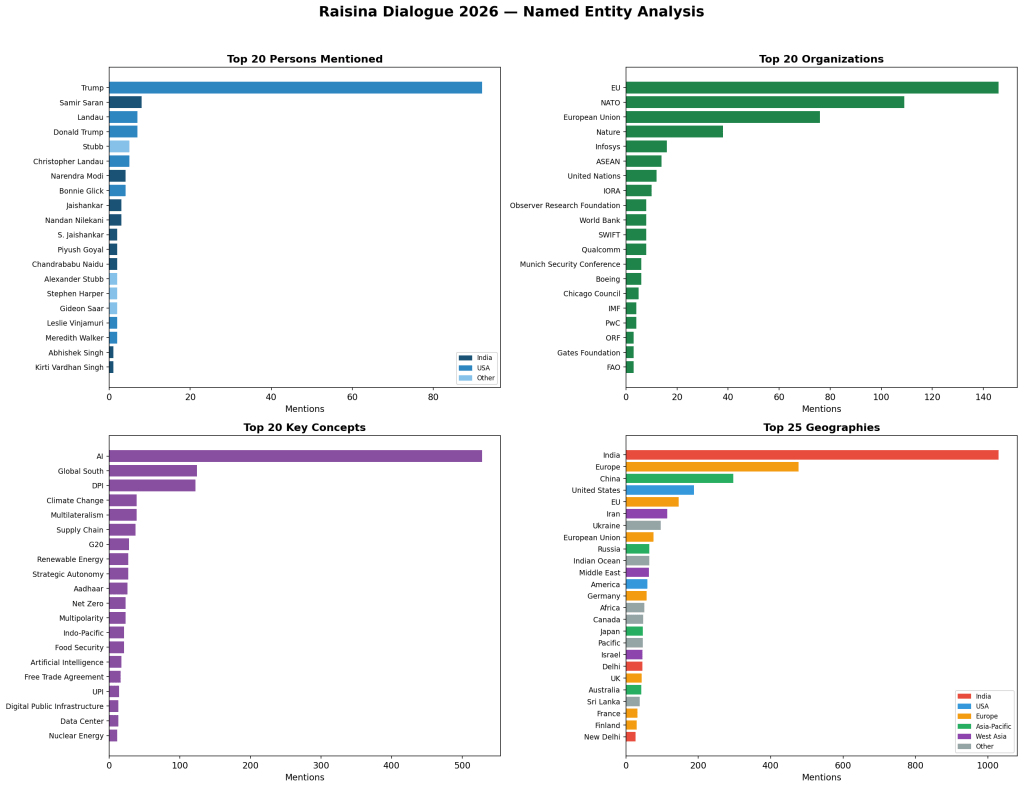
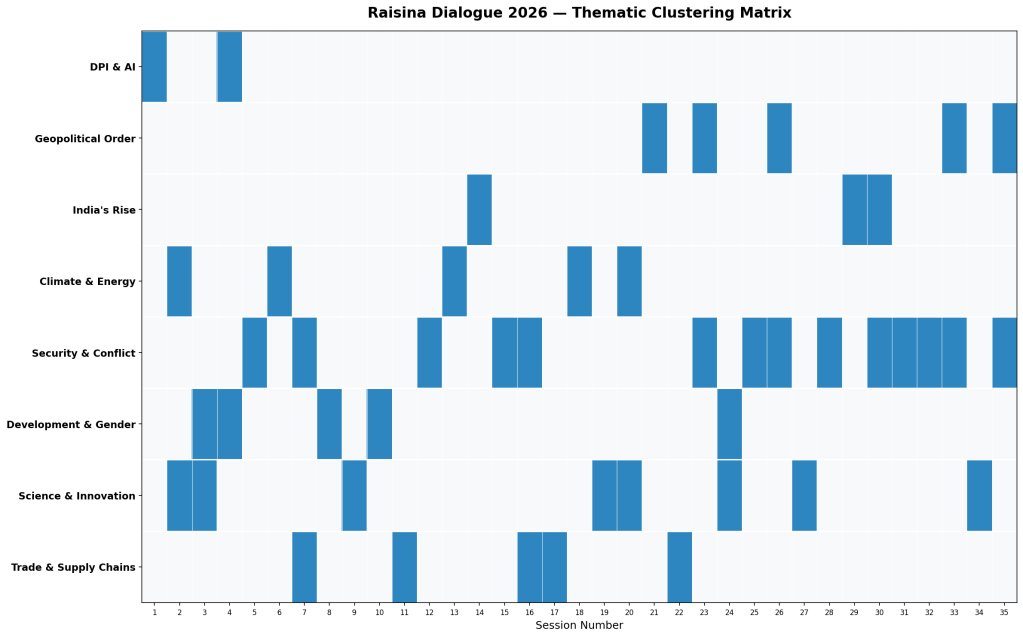
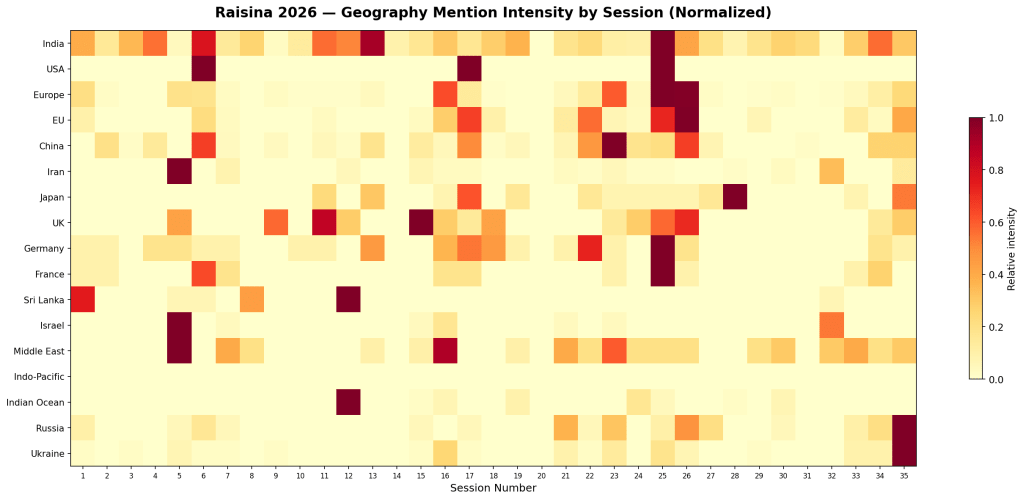

 EmergTech