
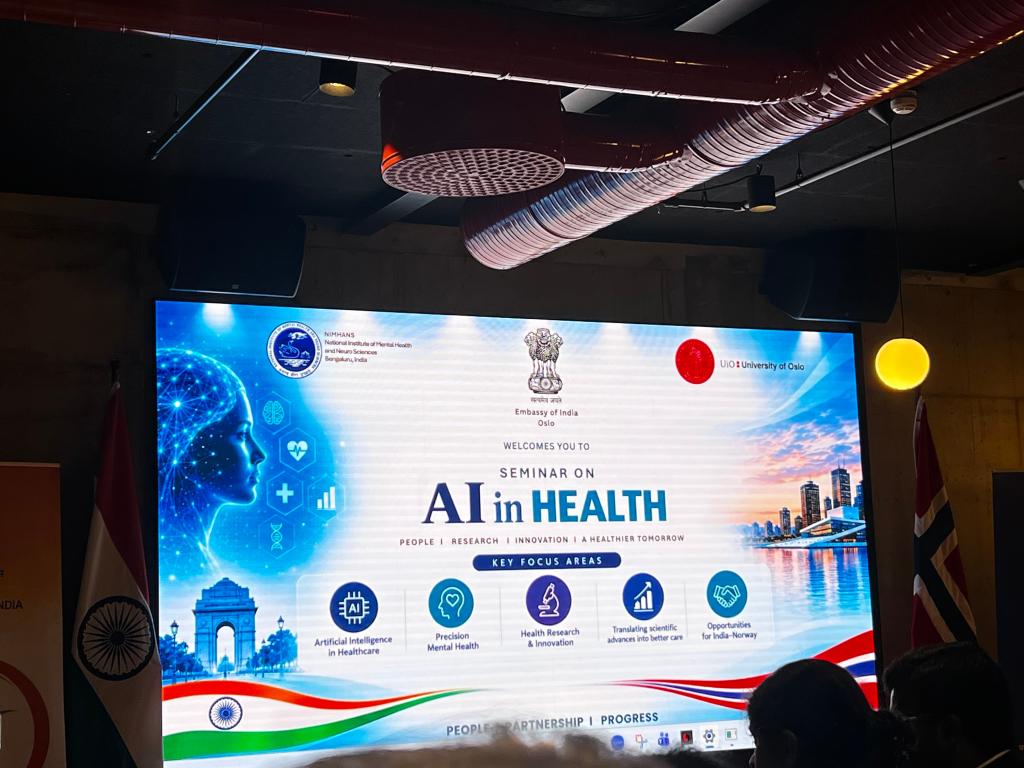
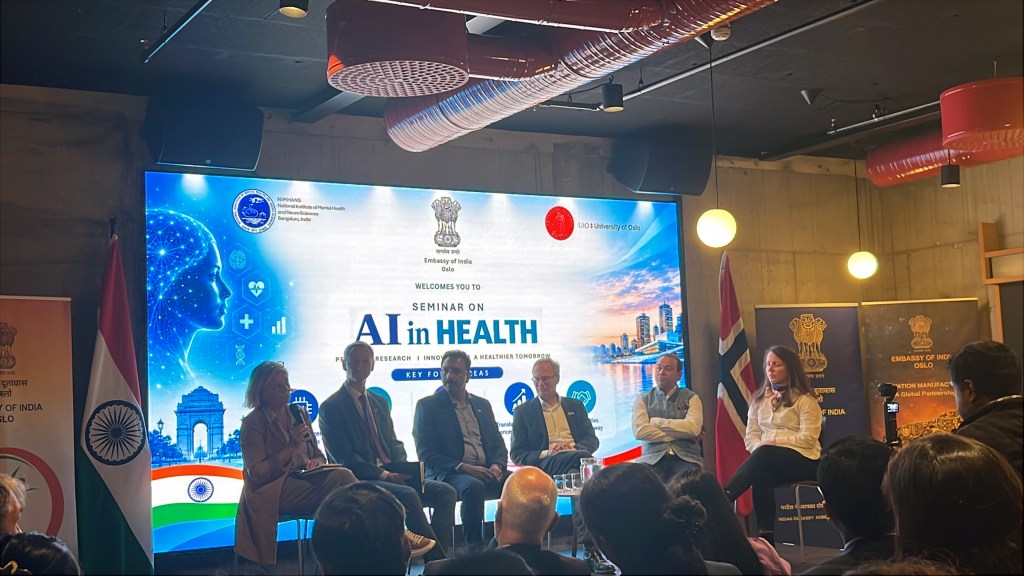
The event at the Embassy of India in Oslo came across less as a generic discussion on “AI in healthcare” and more as an attempt to define the next phase of India–Norway collaboration in health, mental health, precision medicine and clinical AI. The central proposition was that the two countries have unusually complementary strengths: India brings population scale, genetic and clinical diversity, large patient cohorts and the ability to test technologies under heterogeneous real-world conditions; Norway brings high-quality longitudinal datasets, registries and biobanks, trusted research environments, mature digital-health infrastructure, strong governance frameworks and established pathways into public hospitals.
The main message of the event
A recurring theme across almost every intervention was that AI research is no longer the principal bottleneck; translation into healthcare is. Participants repeatedly returned to the gap between a promising algorithm or research paper and something that is validated, regulated, procured, deployed and used routinely by clinicians.
The Norwegian side described this explicitly as a transition from excellent science toward implementation in the public healthcare system. The Research Council of Norway is increasingly interested in strategic health investments and AI, while the South-Eastern Norway Regional Health Authority described its role as connecting research with hospital operations and taking technologies from pilots into deployment. There are already multiple AI-based solutions being used in Norwegian hospitals, but scaling them remains difficult.
An important underlying conclusion was therefore:
The collaboration should not stop at joint research. It should create a pathway from research → validation → clinical evaluation → implementation → scalable products and services.
That logic was also central to the NIMHANS presentation, which described development of scientifically validated tools in both countries, clinical evaluation, prospective joint programmes and ultimately AI-enabled interventions and treatment protocols capable of improving patient care.
Why India and Norway fit together
The strongest intellectual idea of the event was probably the concept of complementarity rather than symmetry.
India offers:
- population scale;
- very high genetic, cultural and clinical diversity;
- established cohorts and deep phenotyping;
- large volumes of multimodal data;
- the possibility of testing whether models generalise across very different populations;
- experience deploying digital infrastructure and health services at enormous scale.
Norway contributes:
- longitudinal cohorts and national registries;
- biobanks;
- mature genomics and statistical-genetics expertise;
- highly digitised healthcare;
- secure research infrastructure;
- trusted research environments and high-performance computing;
- strong governance, validation and clinical implementation systems.
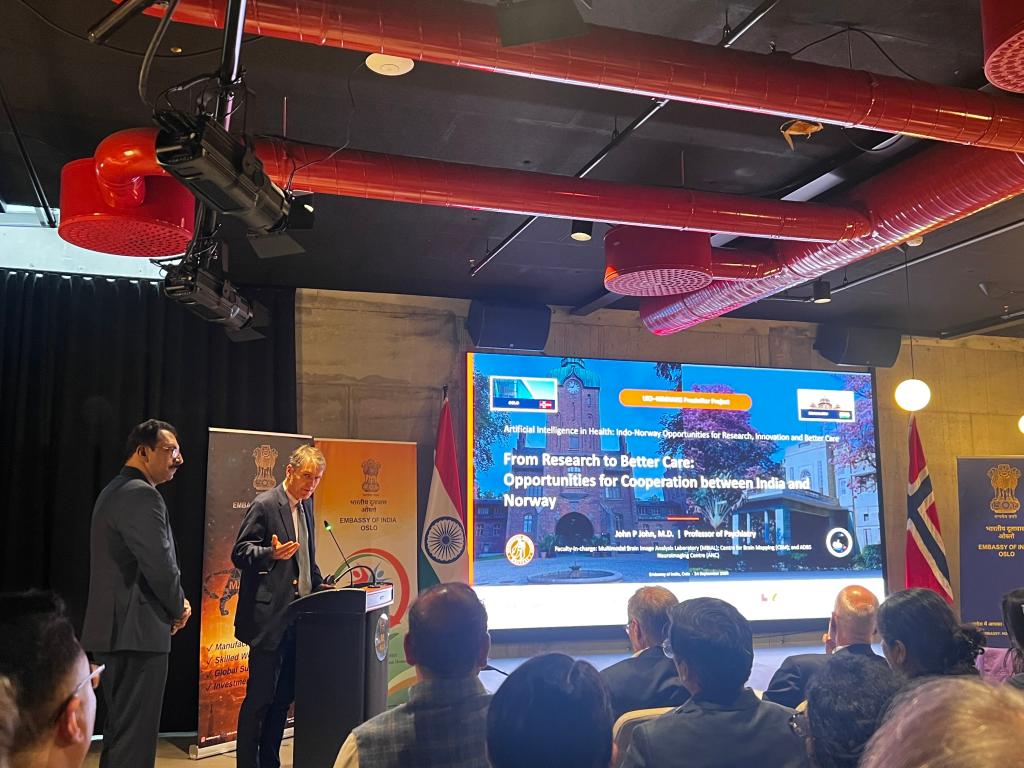
Professor John from NIMHANS made the particularly interesting argument that AI changes India’s role in international healthcare innovation. India is no longer simply a large market for finished technologies. Its scale and heterogeneity can make it an important environment in which globally generalisable AI models are developed and validated.
This creates a potentially powerful two-way model:
develop in Norway → validate in India → improve using Indian diversity and scale → validate again in Norway → deploy internationally.
Or the reverse, depending on where the scientific capability originates.
Mental health and precision medicine
Mental health was one of the central use cases because of the existing University of Oslo–NIMHANS partnership.
The collaboration is built around precision medicine, integrating multiple forms of information rather than relying on one diagnostic signal. The discussions referenced combinations of:
- genetics and genomics;
- brain imaging;
- biomarkers;
- electronic health records;
- clinical assessments;
- environmental information;
- behavioural and potentially mood-related digital measurements.
AI becomes the layer that integrates these different modalities and potentially supports prediction, diagnosis, treatment selection and disease monitoring.
The dementia/Alzheimer’s example was particularly prominent. Participants discussed combining genetics, blood biomarkers, clinical and psychosocial information to develop earlier and potentially more cost-effective prediction models. India could provide large and diverse clinical datasets, while Norwegian research infrastructure and existing models could provide the methodological foundation.
A pragmatic view of AI
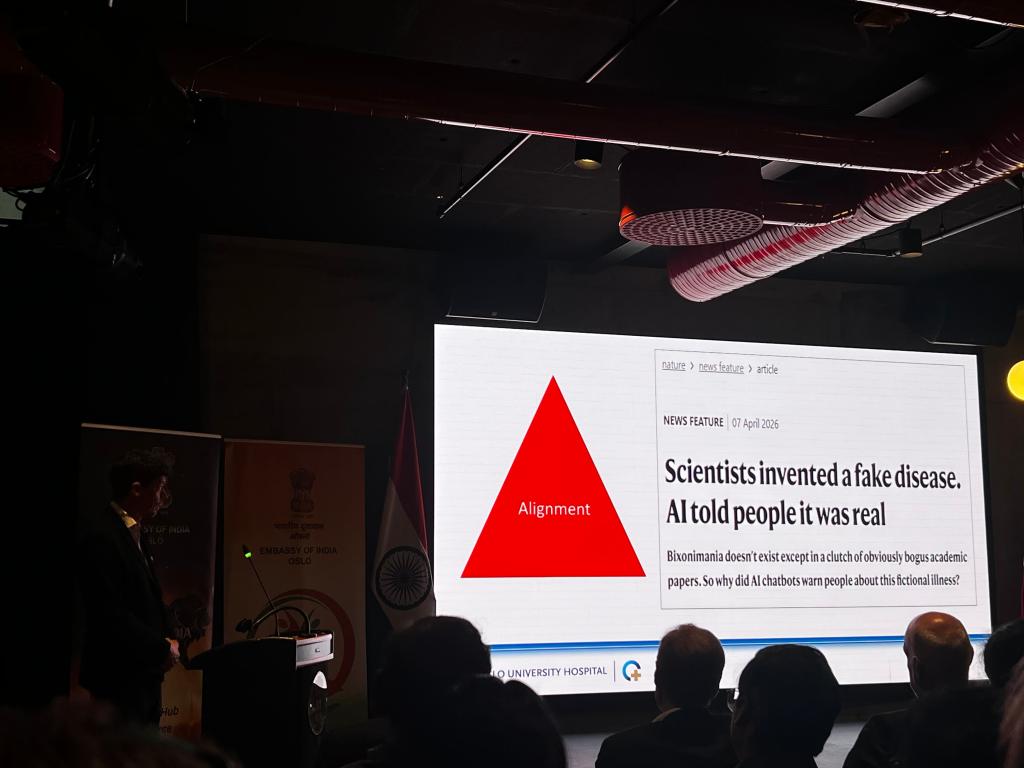
One presentation gave an important caution against treating generative AI as inherently reliable in healthcare. A deliberately fabricated medical diagnosis was used to demonstrate how language models can absorb and reproduce false scientific information.
The lesson was not that AI should be avoided, but that healthcare needs validation, evidence, alignment and controlled environments.
The Norwegian hospital approach therefore begins with relatively low-risk, high-value applications such as:
- speech-to-text during consultations;
- clinical transcription;
- documentation assistance;
- better structuring of electronic health records.
Clinicians reportedly spend a very substantial amount of time on documentation, so even relatively simple AI can generate immediate value without making autonomous clinical decisions. More advanced applications—decision support, prediction and multimodal precision medicine—can then follow once validation and governance are established.
Data architecture may be the real foundation
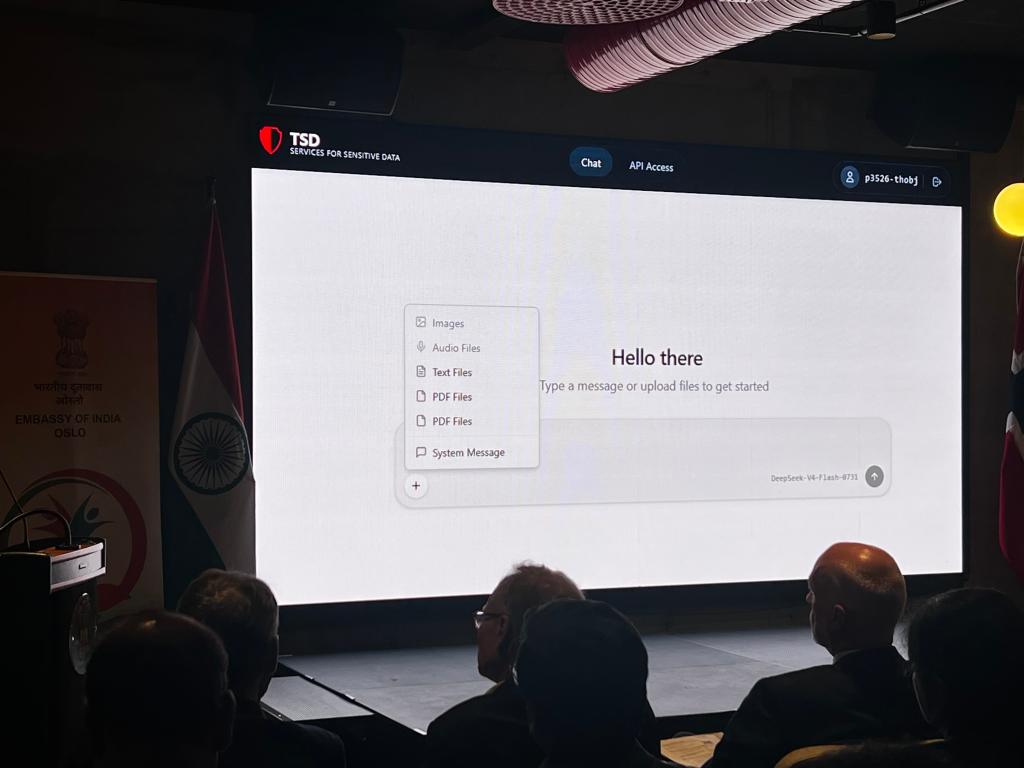
Perhaps the most technically important discussion concerned trusted research environments.
Several speakers argued that healthcare AI cannot depend on routinely moving sensitive patient data between countries. Instead, the emerging model is:
bring computation to the data rather than bring data to the computation.
This means establishing secure research environments in both countries in which identifiable or pseudonymised healthcare data remain locally governed while algorithms and analytical tools operate inside controlled infrastructure.
Federated learning was repeatedly mentioned as an important long-term direction, although participants were refreshingly cautious about portraying it as a completely solved technology today.
A potentially significant area of bilateral cooperation therefore emerged: Norway could share experience in establishing trusted research environments and secure clinical-data infrastructure, while India could implement and adapt these models at much greater scale.
The biggest obstacle: the “validation valley”
A striking amount of the panel discussion converged on the same problem.
Research funding can produce promising prototypes, but clinical development requires:
- larger datasets;
- repeated validation;
- clinical trials;
- regulatory evidence;
- integration with hospital workflows;
- procurement;
- capital.
That stage is considerably more expensive than producing the initial research.
The Research Council representative acknowledged that Norway produces strong research but often struggles to move health technologies into commercialisation and large-scale healthcare deployment. Participants suggested that funding mechanisms may need longer time horizons and greater continuity, rather than relying exclusively on three- or four-year research projects.
There was also some self-criticism from both sides of the innovation ecosystem. Researchers were encouraged to care more about whether their work actually reaches patients, while hospitals were encouraged to engage startups earlier rather than waiting until technologies are fully mature.
Startups and industry need to be inside the collaboration
Industry participation was not treated as something that happens after research.
The startup perspective argued that companies should be embedded from the beginning alongside:
researchers + clinicians + patients + hospitals + regulators + funders.
That gives startups access to real clinical problems and validation populations, while researchers gain partners capable of converting findings into products.
A Norwegian precision-medicine company participating in the event highlighted two particular opportunities from cooperation with India:
- validating multimodal AI algorithms across diverse populations;
- building partnerships or joint ventures with Indian organisations that understand India’s regulatory and healthcare ecosystem.
This was an important distinction: the ambition should not simply be “Norwegian technology sold in India.” It could instead become co-developed technology for global markets.
Health equity was another strong theme
The discussion on antimicrobial resistance provided a good example of the wider relevance beyond mental health.
A Norway–India team has developed machine-learning approaches using data from countries with very different antimicrobial-resistance environments. Technologies developed in Norway are also being clinically tested in India.
The broader argument was that technologies developed in wealthy healthcare systems should not become useful only to wealthy healthcare systems. Designing for India and other lower- and middle-income settings forces researchers to consider cost, scalability, infrastructure and accessibility from the beginning.
The political and institutional backdrop matters
The event was also clearly positioned inside a wider bilateral relationship.
The recently strengthened India–Norway health cooperation framework/MoU was presented as covering digital health, health technology, research, preparedness and institutional cooperation. A joint working mechanism between the health ministries is expected to help carry this agenda forward.
The Norwegian side explicitly recognised India as a major digital-health and innovation partner rather than merely a recipient of Norwegian expertise.
The UiO–NIMHANS partnership appears to be becoming one of the concrete scientific vehicles underneath this broader political framework.
What I would consider the 7 most important takeaways
- India–Norway health cooperation is moving from individual research projects toward a broader strategic partnership.
- Mental health and precision medicine are strong initial use cases, particularly through the UiO–NIMHANS relationship.
- The countries’ strengths are highly complementary: Norway offers high-quality longitudinal data and trusted infrastructure; India offers diversity and scale.
- Trusted research environments and “compute-to-data” architectures could become a major bilateral workstream, potentially more important than simply exchanging datasets.
- Validation and implementation—not algorithms—are becoming the main bottleneck.
- Industry must enter much earlier in the research cycle, together with hospitals, clinicians, patients and regulators.
- The larger opportunity is not simply Norwegian AI entering India or Indian AI entering Norway, but the creation of AI health technologies jointly validated across fundamentally different populations and health systems, making them potentially much more globally relevant.
The opportunity was implicit in the room
There is a fairly clear institutional architecture hiding underneath all these discussions:
NIMHANS / Indian research institutions
↓ clinical scale, diversity, cohorts, domain expertise
University of Oslo / Norwegian research institutions
↓ precision medicine, registries, genomics, AI methodology
Norwegian + Indian secure health-data infrastructure
↓ trusted research environments / federated analysis
Hospitals in both countries
↓ prospective clinical validation
Industry/startups
↓ productisation
Research councils + ministries + investors
↓ long-term funding and scale
Joint India–Norway health innovation pipeline

