
Event summary | Embassy of India in Oslo | 10 November 2026
The Embassy of India in Oslo brought together researchers, industry representatives and the Indian scientific community for its first celebration of World Science Day for Peace and Development. Presentations and three panels explored clean energy and industrial innovation, artificial intelligence, and biomedical research. A recurring message was that India–Norway cooperation should connect scientific knowledge with pilot projects, commercial applications and public benefit, drawing on complementary capabilities in both countries.
Science diplomacy and practical cooperation
In her welcome address, Ambassador H.E. Ms. Gloria Gangte highlighted India’s scientific achievements, frugal engineering and growing innovation capabilities. She linked Make in India with opportunities for Norwegian collaboration in clean energy, maritime technologies, advanced manufacturing and other strategic sectors. Referring to the bilateral green strategic partnership, she encouraged researchers and professionals in Norway to act as bridges between the two innovation ecosystems and help move joint research towards industrial application.
Presentations on research and commercialisation
Dr. Sanjay Mishra of the Institute for Energy Technology outlined opportunities in human-centred AI, digital sovereignty and cybersecurity. Proposed applications included human–AI decision support for energy and industrial operations, trusted data exchange, and digital product passports for circular supply chains. He suggested a technical workshop to identify partners, select a shared use case and develop a pilot before pursuing larger joint proposals.
Dr. Ashish K. Sahu presented Cambi’s experience of developing the Indian market for thermal hydrolysis, which supports resource recovery from sewage sludge through biogas and improved biosolids management. He described research and testing with Indian partners in Roorkee, sustained engagement with municipal authorities and support from public funding bodies. He reported that this work had progressed to two projects in Mumbai, at Malad and Versova, alongside an Indian office and local manufacturing. The case illustrated the importance of adapting technology to local conditions, building trust over time and addressing policy barriers to resource recovery.
Prof. Manikandan Palanichamy of Østfold University of Applied Sciences discussed green hydrogen and sustainable engineering. He highlighted education, research and staff and student mobility as connected foundations for cooperation. Suggested next steps included joint doctoral opportunities and stronger links between Indian and Norwegian hydrogen valley initiatives for knowledge and technology exchange.
Clean energy and industrial innovation
Moderated by Sachin Gaur, the first panel brought together Sambeet Mishra, Arvind Keprate, Ramesh Babu Govindaraj and Marianne Olsen. Discussion covered electricity market design, digital twins for predicting equipment failure, and standards that enable manufacturing for international markets. Environmental assessment was presented as essential to sound industrial development. Opportunities included water management, climate adaptation, nature-based solutions, pollution control and environmentally responsible offshore wind. Panellists also stressed access to quality datasets, industry finance, education and stakeholder participation.
AI and data science for transformative innovation
Moderated by Dr. Arvind Keprate, the AI panel examined changing approaches to education, employment and innovation. Dr. Lester Allan Lasrado discussed how students can retain foundational skills when AI makes answers and code readily available. The exchange reflected differing views on the future role of universities, alongside recognition that teaching and assessment need to evolve. Integrity, judgement and human involvement remained important considerations in recruiting and developing talent.
Dr. Ayan Chatterjee highlighted “green AI”: using computation efficiently, reducing unnecessary model calls and avoiding excessive use of AI agents. Discussion of data centres raised questions about electricity demand, cooling and grid capacity. Sachin Gaur offered a practical perspective on using AI to solve problems and enable entrepreneurship, including hands-on activities with teenagers in Norway. Together, these contributions underlined both the opportunities for wider participation in innovation and the need to consider its resource demands.
Biomedical research and precision technologies
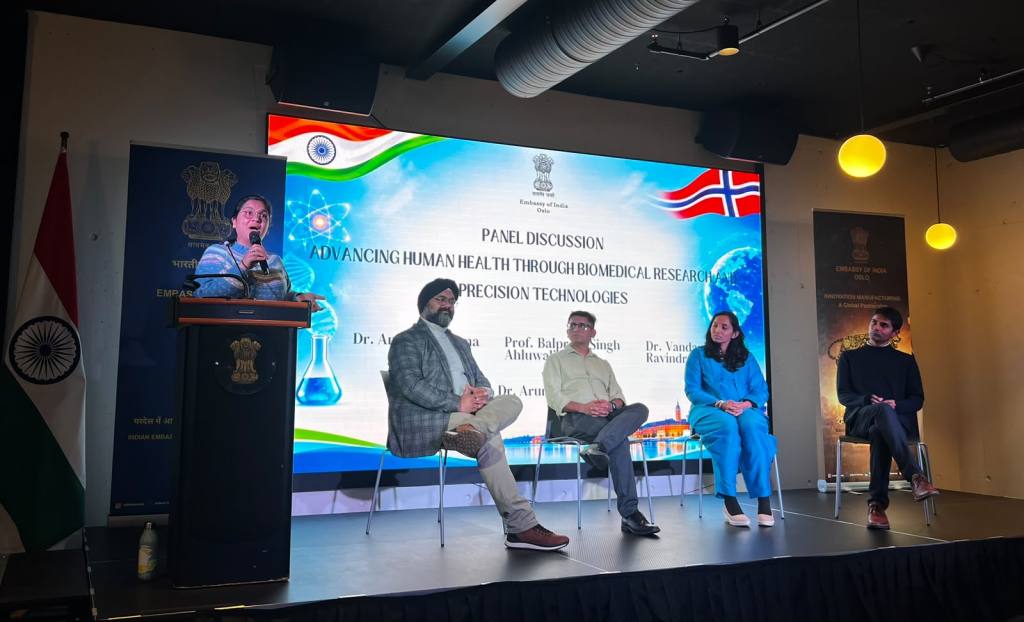
Moderated by Dr. Akriti Sharma, the health panel brought together Dr. Ankush Sharma, Prof. Balpreet Singh Ahluwalia, Dr. Vandana Ravindran and Dr. Arun Kumar. The discussion emphasised reciprocal benefits: India offers substantial clinical diversity, research expertise and manufacturing capacity, while Norwegian partners contribute specialised technologies, research infrastructure and longitudinal patient data.
Ankush Sharma described work on the tumour microenvironment and precision immunotherapy. Potential cooperation included larger, more diverse cancer datasets and research on extracting useful information from affordable routine pathology images. Vandana Ravindran explained how computational biology combines molecular, clinical and other data to identify meaningful disease patterns and possible therapeutic targets, creating opportunities for shared analysis and model development.
Balpreet Singh Ahluwalia discussed advanced imaging and the importance of designing technologies for settings with limited resources, including work on accessible oral cancer screening. He also highlighted how European researchers can learn from Indian experience with diseases such as dengue. Delays in funding release were identified as a practical challenge for international projects. Arun Kumar outlined CEPI’s pandemic preparedness work, including vaccine platforms and the 100 Days Mission. He stressed that faster responses require testing infrastructure, clinical readiness, regulatory alignment and sustained collaboration with Indian institutions and vaccine manufacturers.
Priorities for follow up
The following priorities emerged from the presentations and discussions. They represent proposals and recurring themes rather than a formally adopted action plan:
Develop focused pilots. Bring research institutions and industry together around specific problems in energy, water, trusted AI or affordable healthcare, with clear partners and intended users.
Improve data and standards. Support reliable datasets, compatible methods, responsible data sharing and regulatory alignment so that research can be validated and applied across settings.
Connect funding and implementation. Use technical workshops to develop joint proposals, including opportunities discussed under Horizon Europe, while addressing funding coordination and commercialisation barriers.
Sustain networks and skills. Build on scientific diaspora connections, doctoral collaboration, mobility and practical training, involving public authorities and end users early in project design.

