The role metaverse can play in accelerating memetic innovation and cultural evolution
“The most powerful drive in the ascent of man is his pleasure in his own skill. He loves to do what he does well and, having done it well, he loves to do it better. You see it in his science. You see it in the magnificence with which he carves and builds, the loving care, the gaiety, the effrontery. The monuments are supposed to commemorate kings and religions, heroes, dogmas, but in the end the man they commemorate is the builder.” ― Jacob Bronowski, The Ascent of Man
Jacob Bronowski, David Deutsch, Daniel Dennett, Yuval Noah Harari and many other eminent experts have argued on the role memes have played in the progress of our societies. It is not only genetic evolution which has brought us where we are as a species. The memetic evolution and our ability to store and continue this knowledge as part of our civilization has reinforced our progress.
In the last few decades, the worldwide web has clearly accelerated the spread of memes and globalization of ideas and trends. Having said that, the traditional Internet has been limited in the way we could convey our ideas first using text, then images and now predominantly videos, which still do not provide immersive experiences that virtual reality promises.
Luis Von Ahn argues the human is the smartest computer on the Internet[1]. But we keep all this smartness behind the scenes! Ever since the launch of world wide web we have connected billions of humans behind the computer screen to exchange ideas. What VR promises is to put them from behind the scene to inside the scene! Does that change Internet fundamentally? We need to understand the above statement slightly better to appreciate the shift.
Behind the scenes technologies only capture keystrokes or the movement of a mouse or similar devices as input. Inside the scene technologies like VR have the potential to capture myriad of micro expressions to body movements that is unique to an individual´s self. This full body participation in VR has the promise of completing the capabilities of an of an individual to express herself/himself in cyber space, which may kickstart a whole new level of memetic evolution.
Until recently we have been calling the connected world as a cyber-physical system. In this article we want to argue for expanding this phrase and call it a virtual-cyber-physical world. Or a metaverse like many have started to call it?
Every generation has seen its leading artists from Leonardo da Vinci to Mozart. Physicist David Deutsch argues in his book, the beginning of infinity[2], that the artists who create art are trying to convey a meme which they themselves are often not able to define objectively. The society selects the memes and makes them famous, and from this selection emerges Da Vinci´s and Mozart´s of the world. Yet often we cannot define the beauty in their work objectively.
In the current AI methods using Generate Adversarial Networks[3](GANs) are very popular to learn the style information from an artist’s work. These styleGANs[4] can then transform any other image to the style that the artist may have done. Maybe in future we can also look for some objective measure across styles of artworks to understand the elements of beauty.
Imagine the next generation of creative work that takes place in the metaverse. The creation and interaction with full body participation including micro expressions to nuanced body movements happening with a digital footprint. This forms a complete feedback loop in creation and appreciation of memes as they happen. For the first time ever, it may then be possible to not only understand the origins of a meme but its journey, as well as the features which can objectively encode beauty using future AI methods.
What does it mean for allied industries like robotics?
We have seen that existing methods for training AI are data intensive. But for many problem areas, data does not (yet) exist in digital format. If we want to build robots for the service industry where human interaction is to be optimised, could VR interactions of humans to humans be a starting point as a training dataset, also capturing body language and tacit knowledge or whichever memes apply for the situation? The advances which the metaverse promises enabled by VR with new kind of sensors that acquire haptic, olfactory and tactile information to make VR environment more realistic[5] could also turn out to be useful for transferring learning to the robots for them to be more nuanced with their interactions in the real world.
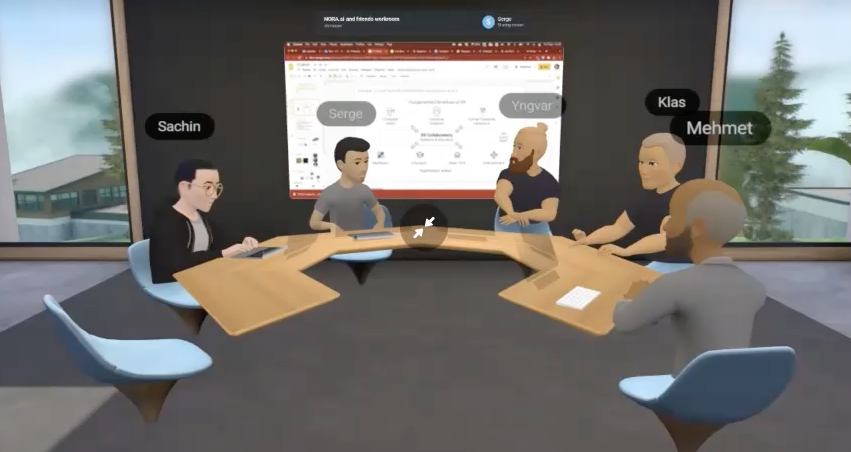
Serge Belongie[6] calls the bigtech metaverses as planets where users will exist. These new planets may then become new kinds of dataspaces which may incubate nuanced robotic innovations for the real world!
I also want to acknowledge contributions of Naci and Serge on this post by providing their feedback.
[1] https://www.smithsonianmag.com/innovation/the-player-165942917/
[2] https://en.wikipedia.org/wiki/The_Beginning_of_Infinity
[3] https://en.wikipedia.org/wiki/Generative_adversarial_network
[4] https://en.wikipedia.org/wiki/StyleGAN
[5] https://ai.facebook.com/blog/reskin-a-versatile-replaceable-low-cost-skin-for-ai-research-on-tactile-perception/
[6] https://scholar.google.com/citations?user=ORr4XJYAAAAJ&hl=en
 EmergTech
One response to “Can VR+AI help us encode objective beauty in an Artwork?”
[…] my last post you can read about the discussion we had with Serge in VR and the ideas it gave me. Serge is […]
LikeLike